Introduction: A Symbol Hiding in Plain Sight
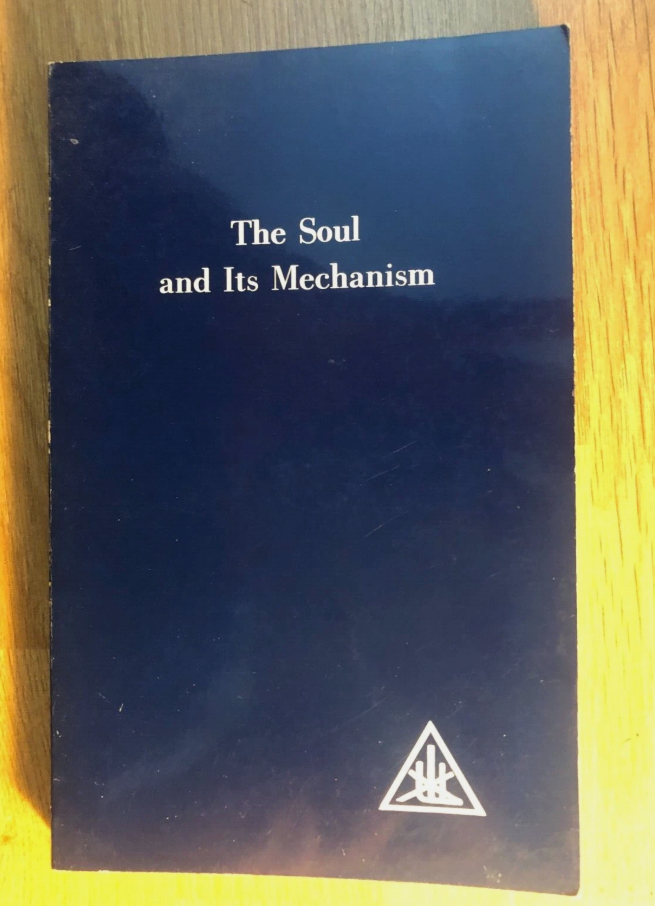
Lux, the Latin word for Light, is concealed within the triangular emblem appearing on many editions of Alice A. Bailey’s books in the bottom right corner, revealing a symbol closely connected with her teachings on spiritual illumination and the awakening of consciousness.
This is particularly significant because Light occupies a central position in Bailey’s esoteric teachings.
Yet the symbolism of LUX extends beyond Bailey’s writings, appearing within the Western Mystery Tradition, the teachings of the Builders of the Adytum and the symbolism of the Tarot.
The Meaning of LUX and LUCIS
The three letters L, U and X are incorporated into the design, forming the Latin word LUX, meaning Light.
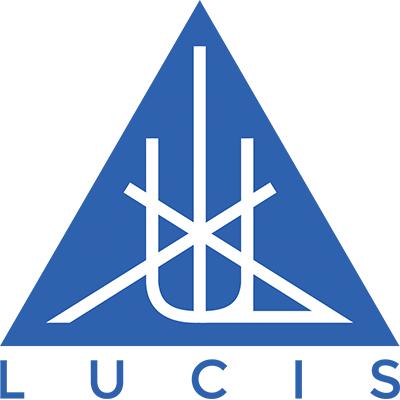
The Latin word Lux means Light, while Lucis is its genitive form, meaning of Light.
Both appear in the emblem associated with the Lucis Publishing Company, established by Alice and Foster Bailey in 1924.
The word LUX is embedded within the triangle, while LUCIS appears beneath it in the fuller publishing emblem.
These connections are examined in an article published by the Lucis Trust entitled Lucis Publishing Company Logo: Underlying Geometry.
The Sacred Geometry of the Triangle
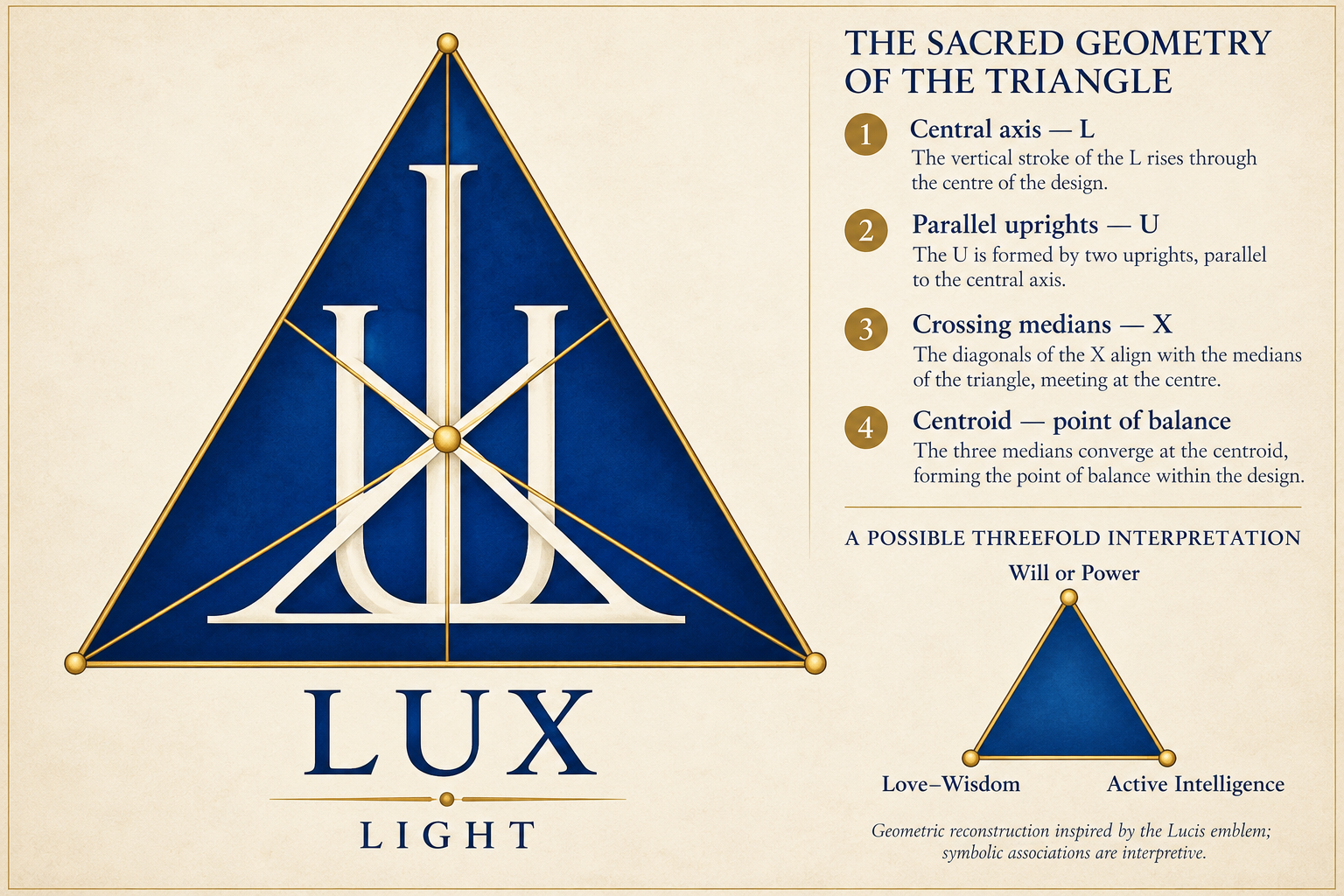
The sacred geometry of a triangle will be discussed in more detail in a later post, however the arrangement of LUX within this specific triangle is especially interesting.
The letter L rises through the central axis of the design, while the U is constructed around the central structure. The X occupies a central position where important geometrical relationships converge.
The three letters share a common baseline, creating a balanced composition within the equilateral triangle.
In Western esotericism, the triangle frequently represents the threefold nature of manifestation.
Within Bailey’s system, one possible symbolic correspondence is the three divine aspects:
- Ray I: Will or Power
- Ray II: Love-Wisdom
- Ray III: Active Intelligence
These are known as the Three Rays of Aspect, expressing fundamental qualities through which divine life manifests.
Although assigning these Rays to the triangle’s three vertices is an interpretation rather than a documented intention of its designer, the symbolism offers an interesting connection with Bailey’s wider teachings.
The triangle may therefore be contemplated as an expression of unity manifesting through three complementary divine qualities.
LUX and the Old Testament
The Latin expression Fiat Lux, meaning Let there be light, appears in the Vulgate translation of Genesis 1:3:
“Dixitque Deus: Fiat lux. Et facta est lux.” This translates to “And God said: Let there be light. And light came into being.”
LUX in the B.O.T.A. Judgement Tarot Card
A particularly interesting expression of LUX can be found in Key XX, Judgement, of the Builders of the Adytum (B.O.T.A.) Tarot, associated with Paul Foster Case.
The card depicts an angel sounding a trumpet above three figures emerging from their coffins.
In Case’s symbolic interpretation, the positions of these figures form the letters L, V and X.
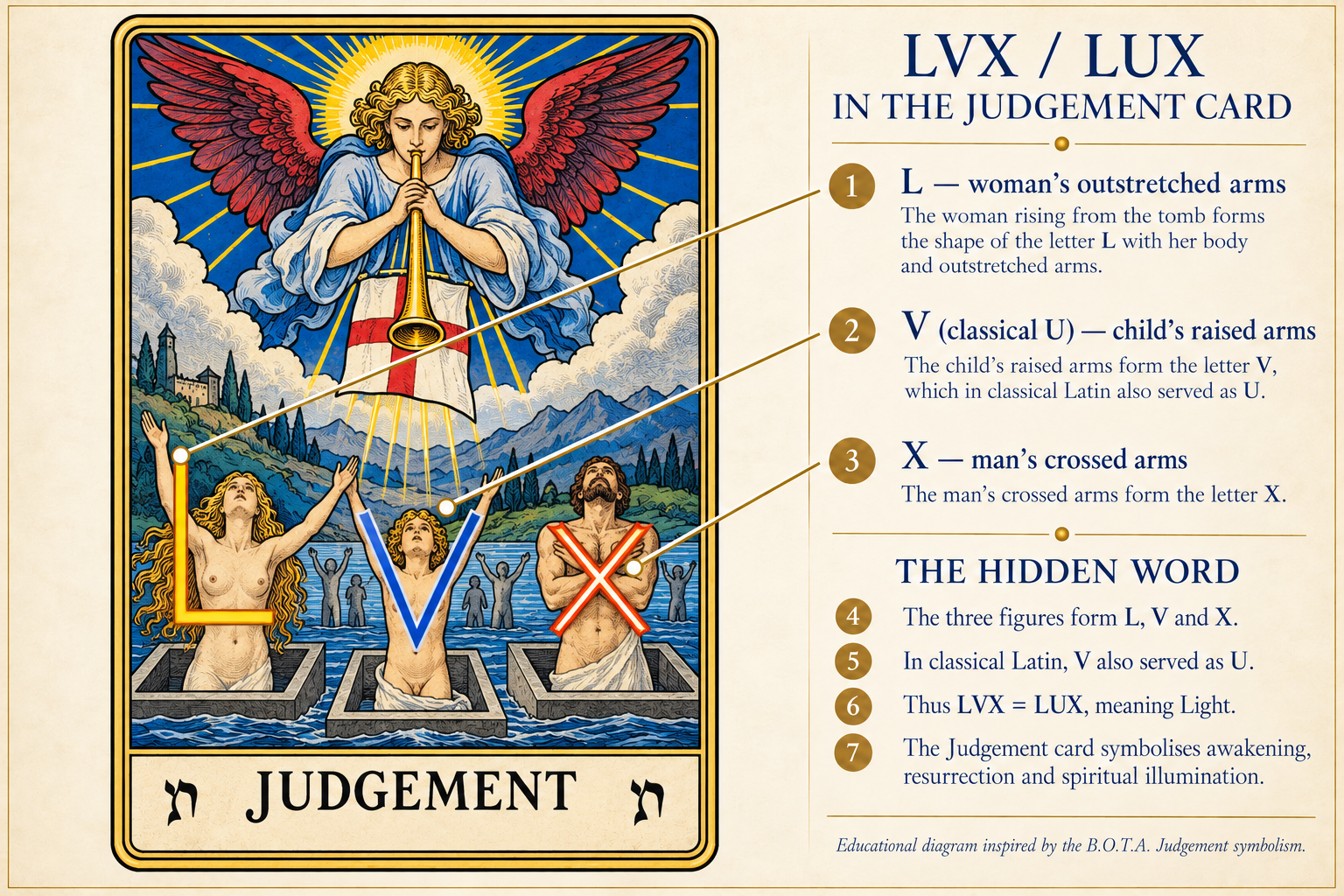
The woman’s extended arms suggest the L, the child’s raised arms form the V, and the man’s crossed arms form the X.
Here the letter V performs the function of U, reflecting classical Latin lettering.
The resulting expression is therefore LVX — Light.
Within the B.O.T.A. tradition, Judgement represents spiritual Realisation, associated with the awakening of human consciousness to its deeper spiritual identity.
The trumpet announces a transformative call to awakening, while the emergence from the coffins symbolises liberation from the limitations of ordinary consciousness.
The Hebrew letter associated with this card is Shin, traditionally linked with the element of Fire.
Paul Foster Case also explored the numerical significance of L.V.X. Using Roman numerals, L = 50, V = 5 and X = 10, giving a total of 65.
Within his Qabalistic interpretation, this number carries additional significance concerning the spiritual Self.
The three figures of the Judgement card therefore present another compelling image of Light: consciousness awakening to a greater reality.
Light as Spiritual Illumination
For Bailey, Spiritual Light represents considerably more than physical brightness.
Throughout her writings, illumination is associated with the development of consciousness, the revelation of truth and an increasing awareness of the soul.
In The Light of the Soul, her interpretation of Patanjali’s Yoga Sutras, she examines the progressive development of consciousness through concentration, meditation and contemplation.
The movement is from identification with the personality towards a greater awareness of the soul and, ultimately, the higher spiritual dimensions of existence.
From a Buddhic perspective, illumination may be understood as an awakening to an underlying unity that is not ordinarily recognised through the analytical mind.
In this context, LUX becomes a fitting symbol for the purpose of esoteric development: the progressive illumination of consciousness.
Lux and the Planes of Consciousness
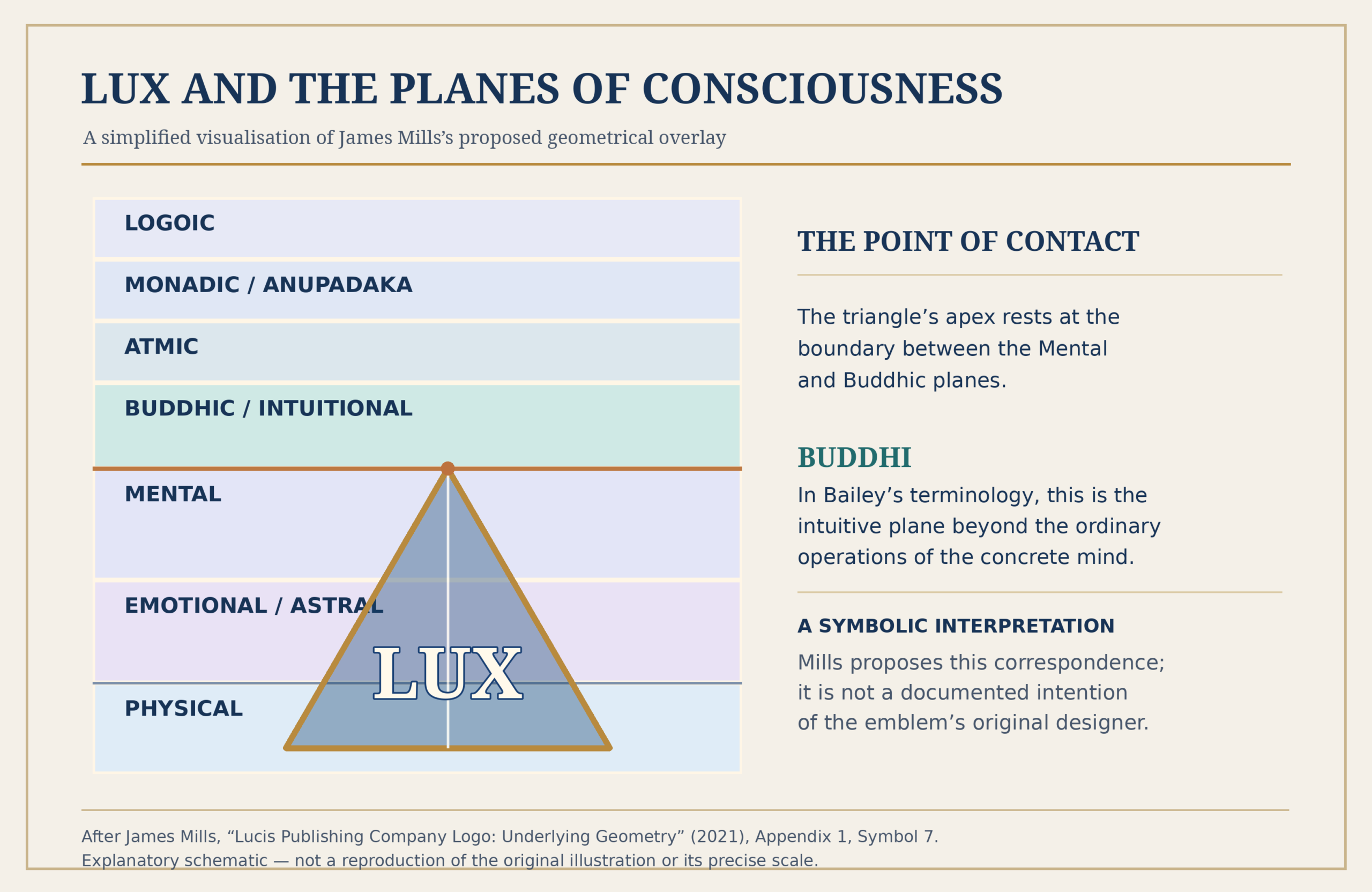
An additional interpretation appears in the Lucis Trust article by James Mills, who explores the emblem’s geometry in relation to Bailey’s diagram of the planes of consciousness.
His speculative comparison places the triangle’s apex near the boundary between the mental and Buddhic planes.
This offers an intriguing symbolic suggestion of consciousness extending beyond the limitations of the ordinary mind.
However, as we will see below, there is an alternative illustration of Lux and the planes of consciousness proposed, in relation to the Path of Light and Sound.
LUX and the Path of Light & Sound
The symbolism of LUX acquires another dimension when considered in relation to contemporary Light and Sound meditation and is illustrated below:
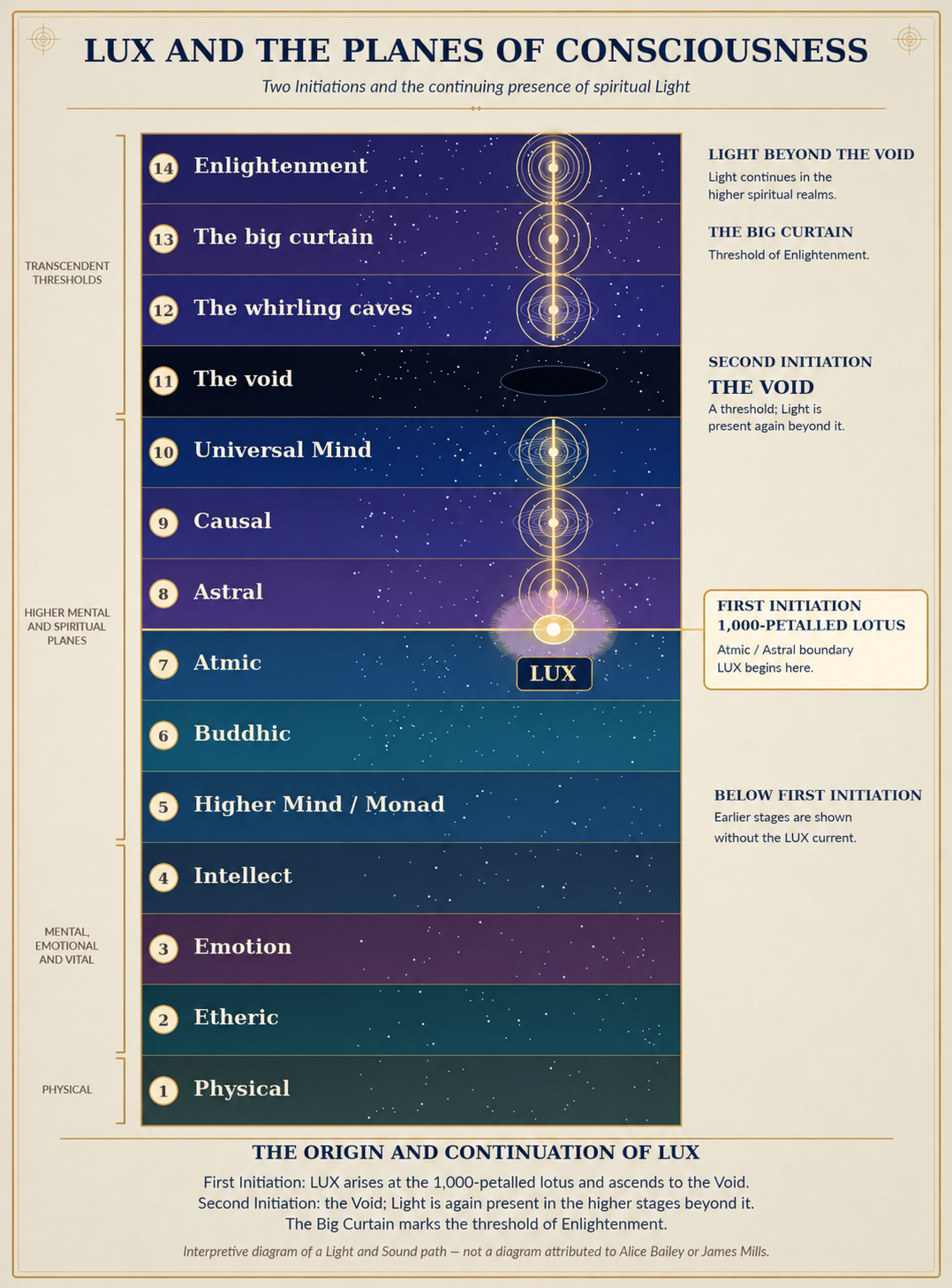
Within these traditions, Light is understood not simply as a metaphor for wisdom but as something that may be directly experienced during meditation.
Practitioners describe an inner luminosity accompanied by what is commonly termed the Sound Current: an interior sound or vibration understood within the tradition to have a spiritual origin.
In Initiation-based approaches, the awakening to these experiences is associated with Initiation, followed by sustained meditation and the progressive exploration of consciousness.
Bailey’s teachings also describe illumination as an experiential process, although her framework of Initiation and spiritual development differs from that of contemporary Light and Sound traditions.
From a Buddhic perspective, the deeper significance of spiritual illumination lies not merely in experiencing Light, but in the possibility of awakening to a consciousness beyond the habitual division between observer and observed.
There is also an interesting symbolic parallel with the B.O.T.A. Judgement card.
The trumpet represents a call to awakening through vibration, while the figures emerge into a new condition of illumination.
Although this does not establish a historical connection between Case’s Tarot and modern Light and Sound initiation, the parallel remains suggestive.
LUX may therefore be understood as a symbol connecting the philosophical understanding of spiritual Light with the revelation of its direct inner experience.
Conclusion: The Deeper Significance of the Triangle
The triangular LUX emblem on Alice Bailey’s books contains considerably more meaning than its modest appearance might suggest.
Its connections with sacred geometry, the Tarot, Western esotericism and spiritual illumination reveal how widely the language of Light has been employed.
Yet the triangle itself invites a further question.
What might happen when three spiritually dedicated individuals consciously work together, combining their understanding, intention and meditative awareness towards a shared spiritual purpose?
Alice Bailey’s teachings place particular emphasis on the significance of triangles, both as expressions of divine relationships and as a means of cooperative spiritual service.
In a later article, we will explore the practical application of triangles, including the possibility of three initiates working together, their relationship to the three Rays and the deeper significance of group consciousness.
The LUX emblem thus provides an introduction to a subject that extends beyond symbolism into the practical application of spiritual understanding.

An Invitation to Experience the Inner Light — LUX
For those who have spent many years studying the writings of Alice Bailey, the concepts of spiritual Light, Initiation and the higher planes of consciousness may have become deeply familiar.
Yet there is a question that naturally arises from such study: Can the Light described in esoteric teachings become a direct and conscious experience rather than remaining something understood through philosophy and symbolism?
Within the contemporary path of Light and Sound Meditation, Initiation is offered as an opportunity to explore precisely this possibility.
Through Initiation, the seeker may begin to experience the inner Light and Sound, understood within this tradition as expressions of a deeper spiritual reality. These experiences can become the foundation for sustained meditation and further exploration of consciousness.
This is not to suggest that Bailey’s teachings and contemporary Light and Sound Initiation are identical. Rather, both recognise the importance of moving beyond intellectual understanding towards spiritual realisation.
For those who feel a genuine inner calling, an invitation to explore Initiation into the Light and Sound is extended openly and without obligation. No particular religious belief is required, and individual experiences may differ.
Further information about the path, preparation and opportunities for Initiation is available through Light and Sound Meditation — Initiation.
Perhaps the ultimate significance of LUX is not simply that the word Light is concealed within a triangle, or expressed through the symbolism of the Tarot.
It is the possibility that the Light towards which these symbols point may become part of our own direct spiritual experience.
From the study of Light to the experience of Light — this is the invitation of LUX.