An Esoteric Geometry Mandala: Philosophy and Application
Introduction
In this post we explore an esoteric geometry mandala, used as a spiritual glyph by the excellent 1Meditation Group.
It is important to bear in mind that the interpretations offered here might vary from the intended meanings by the creator of this mandala, and how the 1Meditation group might interpret it themselves.
The 3 main aims of this post are to :
- Interpret the mandala’s key shapes and colours in clear esoteric terms.
- Apply its insights practically to the Path of Light and Sound, especially for Initiates or meditators who feel stuck in the mind and want to return to direct inner experience of those subtle energies.
- Suggest a method of meditation practise with the mandala.
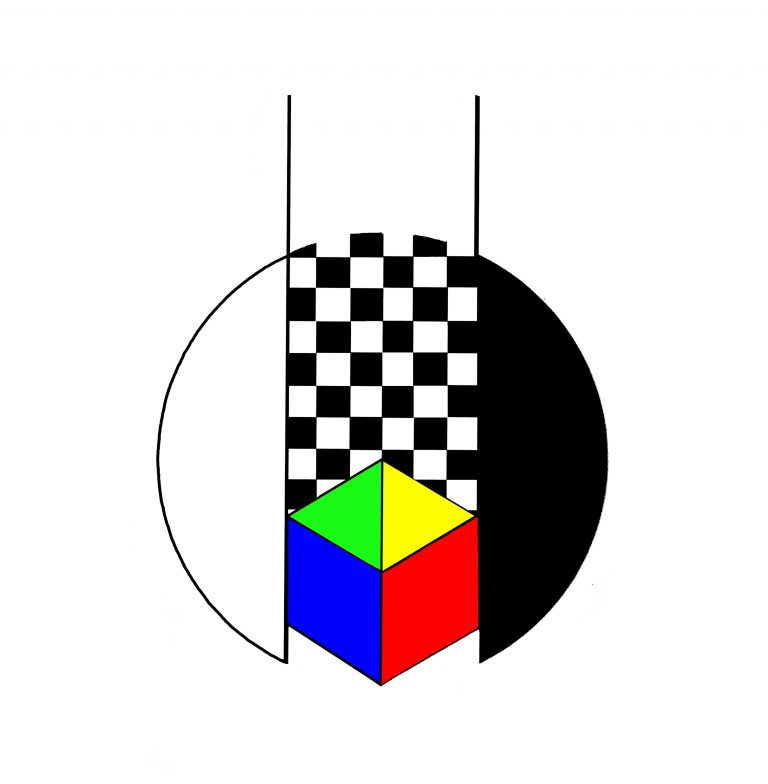
“This image depicts the interface between the manifest mind and the unmanifest Source, and the moment where Spirit enters form.”
1. Esoteric Geometry Mandala: Underlying Philosophy
What does the Outer Circle mean in Esoteric Terms?
-
The large circle represents Totality, the Whole.
-
White half: unmanifest potential, pure awareness, the unseen.
-
Black half: manifestation, density, matter, time.
-
This is not good vs evil; it is before and after creation.
-
The circle’s openness at the bottom suggests creation is an ongoing descent, not a sealed, finished system.
What do the Two Vertical Lines Represent?
-
They are the gate/pillars glyph found in many esoteric systems such as Qabalah.
-
They signify:
-
Duality
-
Polarity
-
The threshold between worlds
-
-
They function as pillars of entry, an initiatory passage from surface attention into the inner field where Light, Sound, silence, or presence become primary.
“Nothing enters form without passing between these two currents.”
What does the Checkerboard Represent?
-
The checkerboard represents the mental plane.
-
It signifies:
-
The dualistic mind
-
Binary perception
-
Thought as contrast
-
-
It is the interpretive grid of yes/no, self/other, light/dark.
-
Esoterically, it is necessary for functioning in form, but it cannot perceive Truth directly, it can only reflect.
- It is described in more detail in the post: The Checkerboard Geometry: Its Relevance to Initiation.
Why Does the Checkerboard Appear Above the Cube ?
The cube represents incarnated life, the Soul seated in form, living through body, heart, mind.
The checkerboard represents the mental plane, the layer where experience is split into opposites
It sits above the cube because, in most people, the mind becomes the manager of the incarnated self. It interprets life and tries to control it.
So the placement is saying:
-
most human living is filtered through mind before it is known as truth,
-
and the mind acts like a “grid” laid over reality.
- The Mind, once seen clearly and transcended (through Second Initiation)
“The checkerboard is not a barrier. It is the last honesty of the mind before it yields.”
What do the Colours of the Cube faces Mean ?
-
The colours show how consciousness is anchored:
-
Blue (left): mind, perception, clarity
-
Red (right): body, life force, action.
-
Green (top left): heart, balance, integration.
-
Yellow (top right): will, individuality, purpose.
-
-
Together they depict a harmonised human Soul or vessel.
“This cube is not the body. It is the Soul correctly seated within the body.”
What is the significance of the Green-Yellow Cube Vertex in contact with the checkerboard?
“Spirit enters as a point because it enters before concept, before comparison, before the mind can claim it.”
-
A heart–will interface:
Green (integration, balance, relational coherence) meeting yellow (purpose, direction, selfhood refined into will). This implies the “doorway” is not intellect, but aligned intention held in a balanced heart. -
Truth impresses the mind without becoming thought first:
Because it is a vertex contact, not a face contact, the mind is touched at a single point, then illuminated from underneath. It suggests gnosis before concept, knowing before explanation. -
Initiation as alignment, not effort:
The mind-plane is not conquered by analysis. It is bypassed by a point of inner alignment. The green–yellow seam implies: when love and will harmonise, the next level opens naturally. -
A “needle-eye” threshold:
The vertex is the narrow gate. It indicates that only what is simple, sincere, unified passes through. Anything complicated, grasping, or agenda-driven tends to spread across the checkerboard and get filtered. -
Practical implication for meditation:
If a meditator is stuck in thinking, the remedy is often not more technique, but returning to:-
soft heart (green)
-
clear intention to surrender (yellow)
Then the Sound steadies, and Light can arise without strain.
-
“Where love and will become one, Spirit can descend into a human life without distortion.”
Why a Vertex, not a Face?
- expanding on the section above:
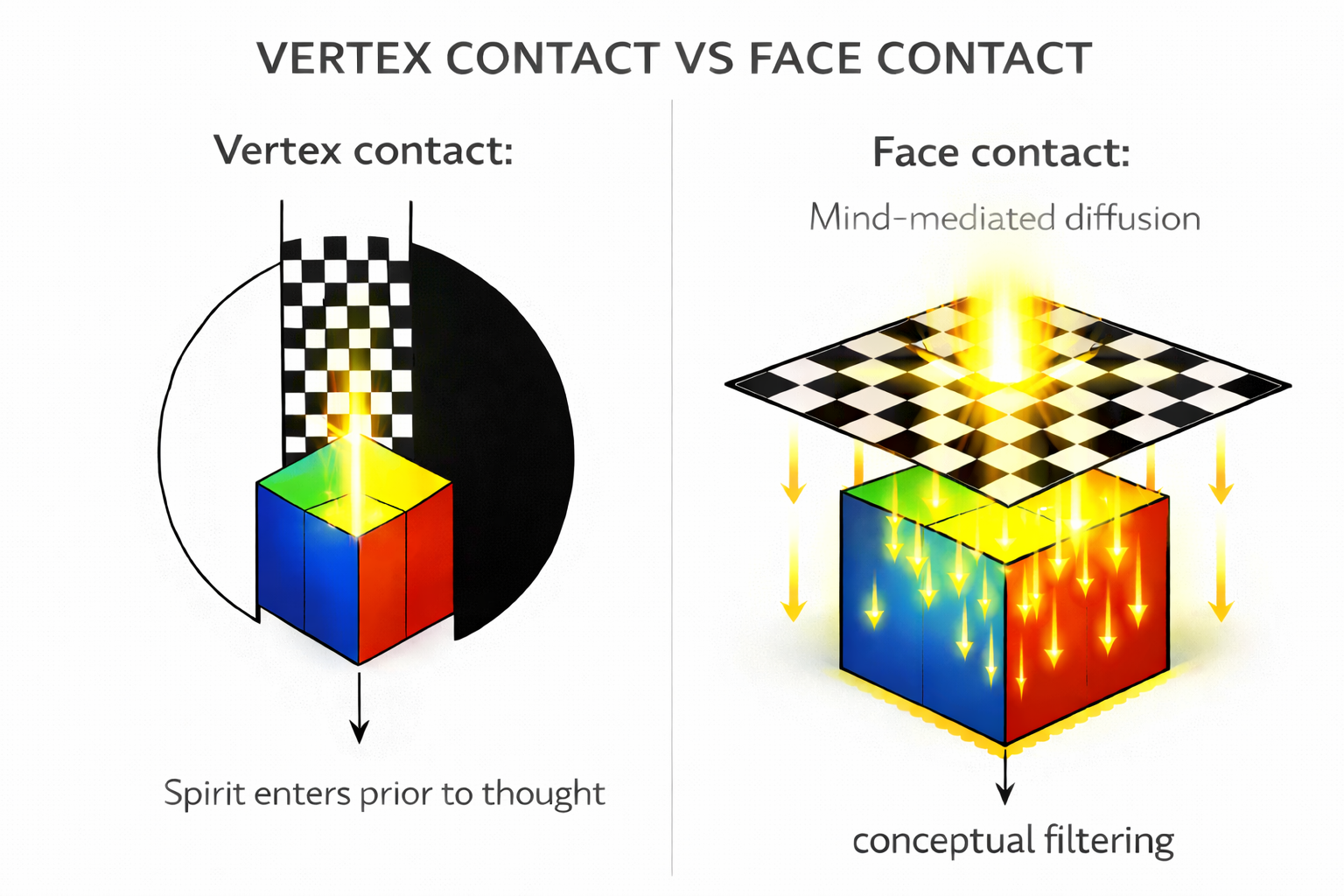
If the cube met the checkerboard across an edge or a whole plane, it would imply Spirit flows into us mainly through thought, analysis, and interpretation.
But a single apex implies the opposite:
-
The mind can witness the entry, but it cannot manage it.
-
The crossing happens through surrender, not understanding.
-
The entry is precise, concentrated, and catalytic, like a spark rather than a flood.
“This point is the ‘needle-eye’ of the journey, the place where the infinite enters the finite without becoming conceptual.”
How does Spirit Move Inside the Cube?
Again, this is esoteric reading, not anatomy, but the diagram strongly suggests a flow:
-
Entry at the apex (green/yellow meeting): a seed of direct knowing
-
Expansion across the top plane: the person becomes oriented inwardly, aligned
-
Distribution into the faces:
-
into blue (mind) as clarity, steadiness, discernment
-
into red (life force) as grounded action, vitality, embodiment
-
This is why the point matters so much: it implies the mind and the body are instruments, not gateways. The gateway is subtler.
What is the Hidden Overall Message of the Whole Composition?
-
The diagram functions as a map of awakening:
-
Awareness arises in the unmanifest (white)
-
It moves through density (black)
-
It becomes filtered by the mind (checkerboard)
-
It anchors into form (cube)
-
The individual becomes a conscious bridge
-
“The purpose of the human is not to escape the world, but to allow the unmanifest to live within it.”
2. Esoteric Geometry Mandala & Path of Light and Sound
First Initiation
Where it sits in the mandala: Checkerboard + the threshold above the cube
-
Typical perception shift:
-
Light: points, wisps, patterns, geometries, starry vistas
-
Sound: tones/high frequencies that strengthen with attention
-
Second Initiation
- Where it sits in the mandala: The two vertical pillars (the Gate)
“The two pillars correspond to the Second Initiation because they signify the gate beyond which the mind cannot follow. They are the standing form of the same truth that later appears dynamically as the Mind Tunnel.”
-
Typical perception shift:
-
Light: less “objects,” more space/presence, sometimes darkness/void-like stillness
-
Sound: more continuous, carrying, less “heard” and more felt as current
-
Enlightenment
- Where it sits in the mandala: The great circle (Totality), with the cube fully permeated
-
What changes in Light & Sound:
-
Light and Sound are no longer “things encountered,” they are known as the texture of Being, and finally even that resolves into pure Oneness.
-
-
What happens to the cube: it represents form, and at Enlightenment it is no longer experienced as a boundary. Life continues, but without a centre.
“The 1st is contact with the currents, the 2nd is release from the mind that interprets them, Enlightenment is the end of the one who was separate from them.”
3. A Suggested Meditation Using The Esoteric Geometry Mandala
Preparation (1 minute)
-
Sit comfortably, upright but relaxed.
-
Place the mandala at eye level or slightly below, about an arm’s length away.
-
Let your gaze be soft, not staring.
Step 1: Soften the mind with seeing (2–3 minutes)
-
Gently look at the mandala as a whole.
-
Don’t analyse. Let the eyes take it in.
-
Notice if the mind starts naming things. Each time it does, silently return to simple seeing.
“Let the image hold your attention so your mind doesn’t have to.”
Step 2: Three anchor points (2–3 minutes)
Move your attention slowly through three simple “rests”:
-
The outer circle: sense wholeness, totality, the bigger space.
-
The middle plane: notice mental activity without following it.
-
The cube/base: feel the body, grounded, present, here.
If thoughts pull you away, return gently to the base and the feeling of sitting.
“Thoughts can continue. Your only task is not to ride them.”
Closing (30 seconds)
-
Open your eyes.
-
Look at the mandala one last time, very softly.
-
Then look away and notice: your room, your body, your life, as part of the same awareness.
“Carry the same quiet attention into the next ordinary thing you do.”
Recommended Meditation Website