Anaximander: Philosophy and Mysticism
Introduction to Anaximander
- Anaximander: Philosophy and Mysticism introduces a Presocratic vision of the apeiron—the infinite source from which all things arise and to which they return. As philosophy, it replaces myth with law-like order and the play of opposites or duality.
- Applied to meditation, it becomes a pointer: Inner Light Sound are not merely experiences to observe, but invitations to trace awareness back to its origin, or the apeiron as Anaximander calls it.
- So Thales’ disciple and successor, Anaximander of Miletus (610-545BC) tried to give a more detailed account of the origin and development of the material world and universe.
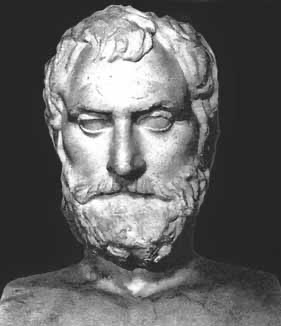
Key Philosophy of Anaximander
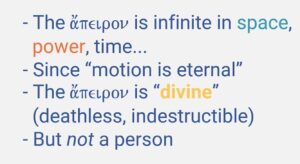
1. The Aperion
According to Anaximander, the material universe formed out of the apeiron (“unlimited”), something both infinite and indefinite (without distinguishable qualities).
2. A cosmos formed by the separation and regulation of opposites
- Within this apeiron something arose to produce the opposites of hot and cold. These at once began to struggle with each other and produced the cosmos (through the tension of opposites or duality).
- The cold (and wet) partly dried up (becoming solid earth), partly remained (as water), and—by means of the hot—partly evaporated (becoming air and mist), its evaporating part (by expansion) splitting the hot into fiery rings, which surround the whole cosmos.
3. Nature Explained by Laws, not Myth
Anaximander offers naturalistic explanations of the universe (based on rudimentary science) , contrasting with earlier accounts that rely on divine interventions from the Gods. He is associated with one of the earliest prose treatises “On Nature,” from which only a fragment survives.
4. Astronomy, mapping, and measurement.
Anaximander is credited (in later testimony) with introducing/using the gnomon (sundial pointer) and producing an early map of the world.
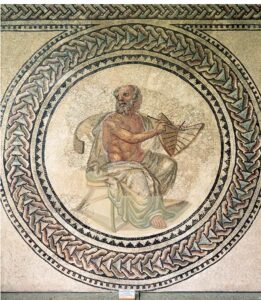
Anaximanders Philosophy Applied to Mysticism
This section maps each the points above to its interpretation through the mystical lens, with specific reference to the Meditation Path of Inner Light and Sound.
1. Apeiron and the Inner Source
On the Path of Light and Sound, Enlightenment is the final State of Consciousness, reached when the meditator transcends all the inner levels of Spiritual Light and Spiritual Sound and merges with the Oneness, the Source of Creation.
2. Balancing Opposites Through Light and Sound Practice
Rather than fighting dualities (pleasant/unpleasant feelings, bright/dim inner light, loud or subtle inner sound), you “let opposites just be ” within awareness— allowing phenomena to balance and resolve in their own time. This is the meditator practising detachment and becoming the observer.
3. A Lawful Inner Path: Cause, Effect, and Contemplative Verification
Examples of “cause → effect” law patterns applied to meditation are:
-
Scattered attention → flickering light / unstable sound
-
Collected attention + relaxed nervous system → clearer, more continuous inner sound current
-
Straining to “see/hear” → contraction of awareness
-
Soft, receptive listening/seeing → refinement and depth of vision.
Why does this matter spiritually ? It keeps the path grounded and testable: Light and Sound are approached as signals of inner alignment and feedback for practice, rather than as proof of specialness or as omens to interpret. That’s the contemplative version of Anaximander’s move from myth to intelligible order. Point 4 follows on:
4. Inner Alignment and Mapping of Experience
Keeping a meditation journal can function like an inner cartography—tracking cycles and changing meditation parameters based on cause and effect to improve the quality of one’s meditation.
Meditation Links
Philosophy Links
