Who Was Ken Carey?
Ken Carey (1949–2017) was a spiritual writer best known for The Starseed Transmissions and the later books Vision, Return of the Bird Tribes and The Third Millennium. He was also involved in education and environmental work and became the founder and administrator of Greenwood School, an experimental educational project in the United States.
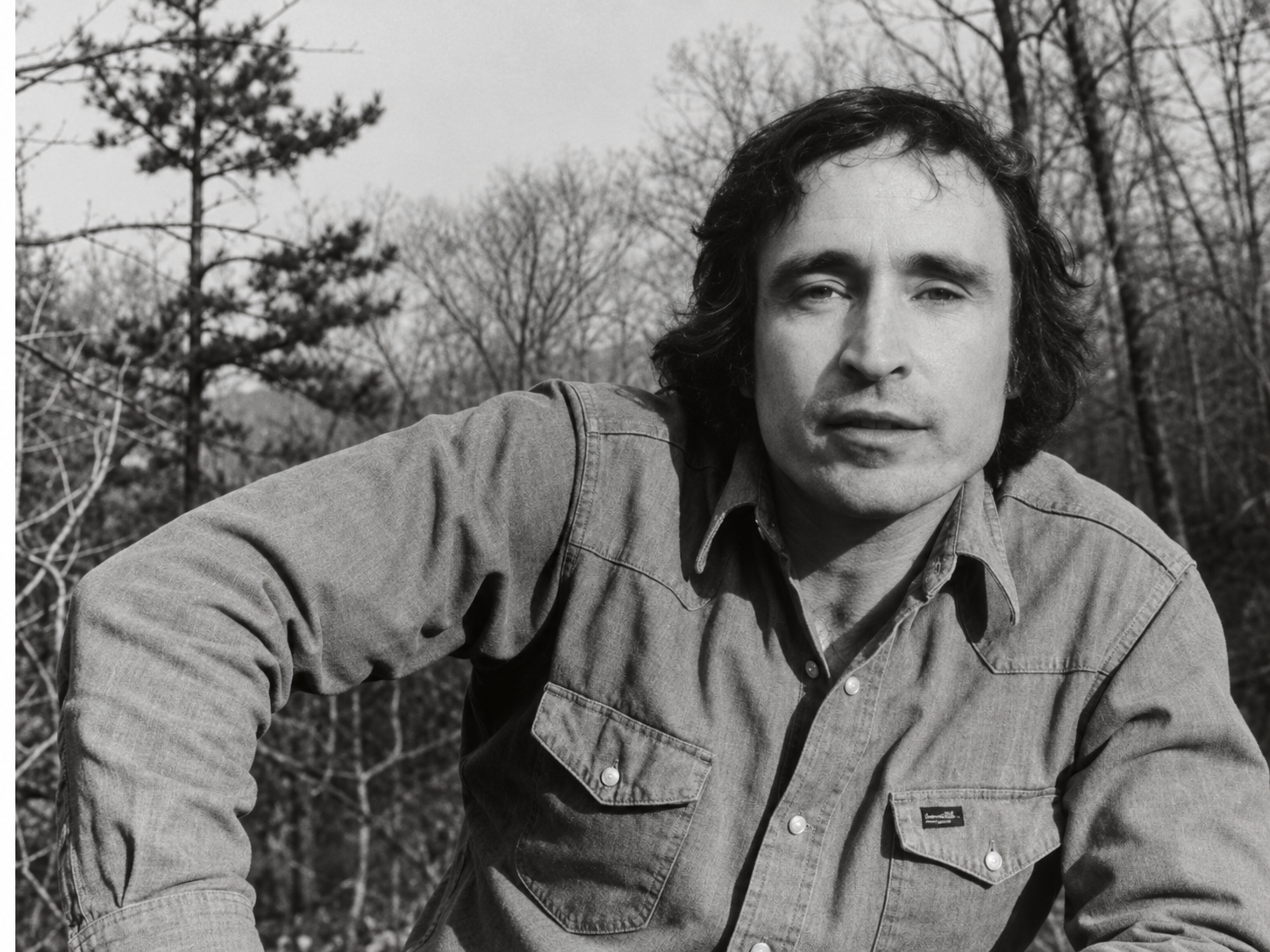
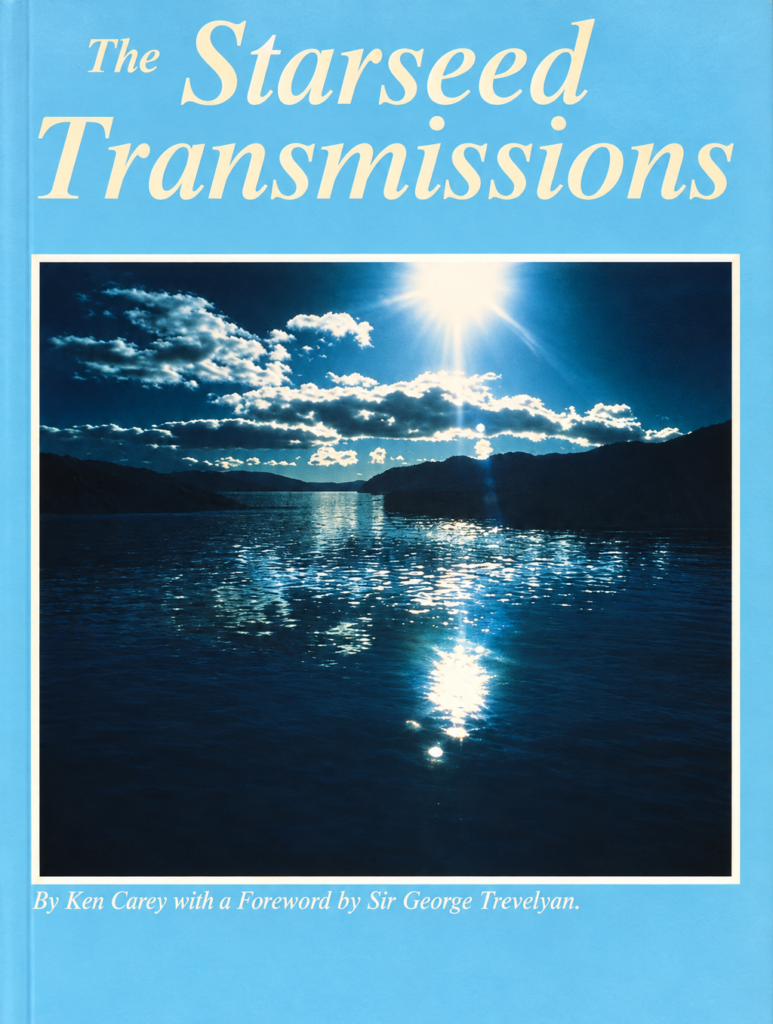
Carey’s work belongs broadly within the spiritual and channelled literature that emerged during the latter part of the twentieth century, although The Starseed Transmissions ranges far beyond the modern idea of simply being a “starseed.” Its central themes are the nature of consciousness, humanity’s spiritual origin, the apparent separation of Spirit and matter, Christ consciousness, the role of higher intelligences, and an anticipated transformation of human awareness.
How Did The Starseed Transmissions Come About?
Carey stated that the material forming The Starseed Transmissions was received during an intense eleven-day period, from 27 December 1978 to 6 January 1979.
He described the communication as initially arriving not so much as spoken sentences but as non-verbal waves containing what he called “meta-conceptual information.” His task was then to translate this more holistic form of communication into ordinary human language. Carey later removed some repetition and arranged the material into chapters, but maintained that the substance of the transmissions was presented essentially as he had received it.
The communicating intelligence variously speaks from the perspective of an angelic or extraterrestrial consciousness, the collective consciousness of humanity and, in the later chapters, explicitly through the voice of Christ. The distinction between these identities gradually becomes less important because one of the book’s central teachings is that apparently separate consciousnesses originate within a single universal Being.
The following is a summary of the book’s twelve principal chapters. It presents Carey’s spiritual cosmology as described in the text rather than making a claim about the objective reality of the events or beings described. There is a Buddhi Interpretation to conclude where we go beyond the constraints of the text to suggest some spiritual principles underlying the books message which may not be obvious to the reader.
The Central Message of The Starseed Transmissions
Although The Starseed Transmissions contains a complex cosmology involving extraterrestrial intelligences, angels, Christ consciousness, planetary evolution and future transformations, a relatively simple spiritual teaching runs through the entire book:
Human beings have become identified with their individual physical existence and have forgotten that their consciousness originates within a much greater spiritual unity.
Carey’s transmissions describe human history as a period of temporary forgetting. Awakening is the reversal of that process.
The movement of the book can therefore be summarised as:
Spirit → incarnation → identification with matter → separation → remembrance → awakening → unified consciousness
The goal is not ultimately to escape physical existence. Rather, humanity is invited to rediscover its spiritual identity while embodied, allowing Spirit and matter to become consciously reunited.
Read in this way, The Starseed Transmissions is less a book about beings arriving from somewhere beyond the Earth than a book about consciousness remembering its origin and learning to express that awareness through human life.
Chapter 1 — Singularity of Consciousness
-
- The transmission opens from the perspective of an intelligence existing within a timeless realm that Carey calls the Presence.
- Individual identity is presented as secondary to a much deeper state of universal consciousness.
- Humanity currently perceives itself as billions of separate individuals, whereas the transmitting intelligence sees humanity as manifestations of one consciousness expressed through many forms.
- Physical identification has caused human beings to forget their wider spiritual identity.
- Ordinary language is described as inadequate because words divide reality into separate objects and concepts.
- The purpose of the transmissions is therefore not simply to provide new information but to help awaken dormant ways of directly knowing and receiving information through consciousness itself.
- Humanity’s future development depends upon recovering its awareness of unity while continuing to function through individual physical forms.
Chapter 2 — The Other Reality
- Carey distinguishes between the familiar world of forms and another level of reality rooted directly in the Creator.
- In humanity’s natural spiritual condition there is no absolute identity separate from God; individuality emerges primarily through relationship and manifestation.
- Consciousness originally moved freely between its individual expression and its awareness of unity with the Creator.
- Carey describes this as an oscillation between form and Being, or between differentiated existence and undivided consciousness.
- The Fall occurred when human awareness became increasingly fascinated with the world of form and gradually forgot how to return consciously to its spiritual source.
- Human beings therefore came to regard physical identity as their primary reality instead of one temporary expression of a much greater consciousness.
- Spiritual awakening involves recovering the ability to recognise both realities without rejecting physical incarnation.
Chapter 3 — The Shadow of Future Creation
- Creation is presented as having a vast rhythm of expansion and contraction, compared with the traditional image of the out-breathing and in-breathing of Brahma.
- Humanity occupies a special position between Spirit and matter, capable of bringing spiritual consciousness consciously into physical creation.
- The descent into matter resulted in humanity becoming increasingly identified with its physical creation and forgetting its original spiritual identity.
- Carey introduces higher or angelic intelligences that remained sufficiently free of this identification to preserve awareness of humanity’s true nature.
- These beings consequently function as reminders and guides, helping humanity eventually rediscover the spiritual consciousness from which it originated.
- The Christ impulse is associated with the beginning of a major restoration of contact between humanity and this higher order of consciousness.
- What appears from the human perspective to be an approaching spiritual future is therefore described as something whose influence has been present throughout the evolutionary process.
- Humanity is moving toward a point at which Spirit and material creation can once again become consciously reunited.
Chapter 4 — An Interval of Non-Time
- Carey describes
 a future cosmic threshold associated with the universe reaching a point of maximum expansion.
 - At this point, he says, the processes sustaining ordinary physical manifestation will momentarily become suspended.
- This produces what the transmission calls an interval of non-time.
- The event is portrayed less as ordinary chronological history and more as a profound shift in the relationship between consciousness, time and matter.
- Various religious prophecies concerning transformation, judgement and the Second Coming are interpreted as partial cultural descriptions of this same underlying event.
- Humanity’s preparation is primarily a preparation of consciousness, rather than physical survival in the conventional sense.
- Those who identify principally with Spirit rather than with fixed material definitions are presented as better able to participate consciously in the transformation.
- The chapter therefore develops the book’s repeated idea that humanity is approaching a transition from matter-dominated consciousness toward conscious participation in Spirit.
Chapter 5 — Mobile Cities of Light
- Carey places the transmissions within three periods of spiritual communication: 1967–1969, 1977–1979 and 1987–1989.
- These periods belong to what the text calls the phase of Individual Awakening.
- Individual spiritual awakening is expected eventually to become sufficiently widespread to generate a collective transformation of humanity.
- This is followed in Carey’s scheme by a much longer period of Planetary Awakening.
- Humanity gradually learns to experience itself as a coordinated planetary consciousness rather than a collection of competing individuals and nations.
- Angelic or extraterrestrial intelligences are described as assisting this transition while attempting not to override human freedom.
- Carey anticipates an increasing interaction between humanity and these higher intelligences, ultimately including more direct forms of manifestation.
- Ecological restoration, cooperation and a radically changed relationship with the Earth are presented as natural consequences of the change in consciousness.
- The emphasis remains upon choosing love, cooperation and awakening rather than fear and separation.
Chapter 6 — A Psychological Process
- The mechanism of awakening now becomes much more practical and inward.
- Carey describes the present moment as the gateway between ordinary human consciousness and divine awareness.
- Humanity’s normal identity is maintained through memories of the past, expectations of the future, conceptual definitions and habitual thought.
- Guilt binds consciousness to the past, while fear projects it into the future.
- The spiritual transformation therefore requires an identity shift rather than the acquisition of additional intellectual knowledge.
- The meditator or seeker gradually recognises that they are not merely the physical form but the life and consciousness animating that form.
- Attention becomes extremely important: where attention is placed determines the reality that consciousness experiences.
- Releasing habitual interpretations allows consciousness to become increasingly receptive to intuitive or “living” information arising directly in the present.
- What Carey calls Satan is interpreted principally through the structures of fear, separation, judgement and identification with past conditioning.
- The return to grace is therefore an awakening from false identity into the immediate Presence of God.
Chapter 7 — The Dance of Life
- Once consciousness begins to function from the present rather than from conceptual conditioning, life becomes more spontaneous and intuitive.
- Carey compares this condition with childhood, before the conceptual mind has completely enclosed experience within fixed definitions.
- Human beings possess deeper informational systems that can guide behaviour more effectively than continuous rational analysis.
- The awakened person increasingly trusts this inner intelligence and learns to respond directly to circumstances.
- Carey describes a series of vibrational channels through which different individuals fulfil different functions within the larger planetary organism.
- Spiritual purpose is not imposed externally; it is discovered through sensitivity to one’s own deepest nature.
- Each person’s authentic work becomes part of a larger harmonious pattern — the dance of life.
- Spiritual transformation ultimately involves relinquishing identification with body, thought, role and personal history.
- The decisive shift itself may occur suddenly: preparation may take time, but recognition of one’s deeper identity can be immediate.
- Carey’s essential practical instruction is therefore to be fully present in whatever one is doing and allow intuitive consciousness to emerge from that presence.
Chapter 8 — Planetary Symphony
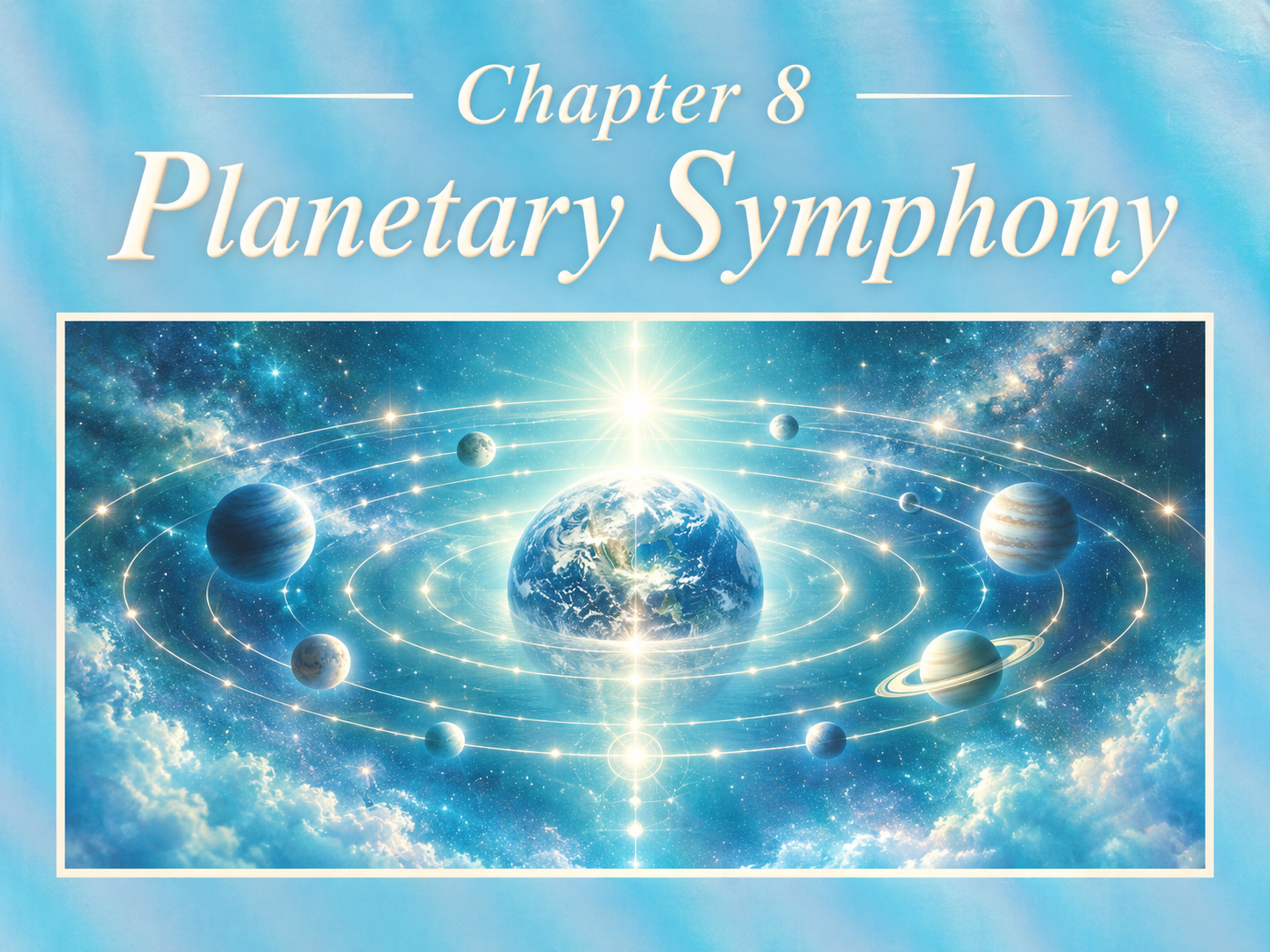
- Humanity in its ordinary state is compared to an orchestra whose musicians are playing independently and without awareness of the whole composition.
- Awakening introduces an inner Conductor — the universal intelligence through which individual lives begin to harmonise.
- Each person remains distinct but recognises themselves as an equally important part of a much larger organism.
- Carey increasingly identifies this unified human consciousness with Christ.
- Christ is therefore presented not only as the historical Jesus but as the collective spiritual consciousness of awakened humanity.
- Personal importance and personal inferiority both begin to disappear because every individual is understood as a necessary expression of the whole.
- Service replaces competition as the natural expression of awakened consciousness.
- Finding one’s true function within life produces peace because personal activity becomes aligned with the movement of the greater whole.
- Humanity’s transformation is ultimately envisioned as the emergence of a coordinated Planetary Being in which individual consciousnesses function together while retaining their unique expressions.
Chapter 9 — Islands of the Future

- Carey predicts the development of communities and centres whose atmosphere supports the emerging state of consciousness.
- He calls these “islands of the future” because they represent small expressions of a new civilisation appearing within the old.
- Such communities are intended to support spiritual transformation rather than create another rigid religion or institutional hierarchy.
- Different centres may have different methods and emphases while participating in the same underlying movement toward unity.
- Genuine spiritual leadership is presented as service rather than authority over others.
- Each person remains responsible for his or her own awakening; no leader should arbitrarily dictate another person’s spiritual path.
- Technology and mass communication can temporarily become important instruments for spreading ideas that help transform consciousness.
- Carey warns groups against believing themselves specially chosen or spiritually superior.
- Different teachings may be appropriate for different people, while all genuine paths eventually converge toward a common spiritual centre.
- These communities are ultimately envisioned as a worldwide network through which love, cooperation and new forms of human relationship gradually spread.
Chapter 10 — The Living Information
- The voice of the transmission increasingly identifies itself directly with Christ consciousness.
- Christ is described as a unified consciousness shared at a deeper level by humanity as a whole.
- Jesus of Nazareth is presented as an individual through whom this collective Christ consciousness became exceptionally awake and visible.
- His teachings — love of enemies, humility, service and freedom from material attachment — were intended to loosen humanity’s identification with matter.
- Carey argues that later religious institutions frequently concentrated upon doctrines, organisations and interpretations rather than actually living Christ’s teachings.
- True spiritual information is therefore described as living information rather than dogma.
- The essential message of Christ is love, unity and direct relationship with the divine Presence within.
- Differences in religious language become secondary when the consciousness behind the language is recognised.
- Grace is not portrayed as something to possess; it becomes stronger as it flows through a person toward others.
- Humanity is invited to relinquish rigid definitions of self so that Christ consciousness can increasingly become the organising principle of life.
- The Second Coming is consequently portrayed not merely as the arrival of an external figure but as the awakening of Christ consciousness within humanity itself.
Chapter 11 — Education of Spirit
- As fear decreases, Carey predicts that humanity’s complex external systems of regulation will gradually give way to a much simpler spiritual principle: the law of love.
- Awakening requires learning to perceive life without immediately imprisoning it within inherited definitions.
- The heart and intuitive consciousness become increasingly important as means of receiving spiritual direction.
- Carey compares humanity to an acorn that mistakenly believes its present form represents the entirety of its identity; spiritual awakening reveals the greater potential already contained within it.
- The Christ presence is described as approaching humanity both from within and from without.
- This awakening is not restricted to one religious denomination, culture or spiritual vocabulary.
- Scientists, ordinary people, children and those outside conventional religion can participate equally in the emerging consciousness.
- The test of genuine spiritual awakening becomes the presence of love rather than conformity to a particular theology.
- Humanity is not simply expected to receive spiritual information and then act upon it; awakened people themselves become the living expression of that information.
- The chapter therefore presents spiritual education as remembering what consciousness already is rather than accumulating additional beliefs.
Chapter 12 — An Open Ending and a New Beginning
- The final chapter places humanity’s present condition within a much larger evolutionary story.
- Recorded human history is portrayed as a kind of gestational or embryonic phase preceding the birth of humanity as a consciously unified planetary organism.
- The coming phase of Planetary Awakening represents humanity’s spiritual childhood rather than the completion of its evolution.
- Carey imagines a far more distant future in which awakened humanity participates consciously within a wider galactic community.
- Technology itself is envisioned as eventually becoming increasingly organic and integrated with consciousness rather than separate and mechanical.
- Spirit and matter progressively cease to appear as opposing realities.
- Humanity discovers itself to be a living expression of the same intelligence operating throughout creation.
- The repeated message is that the knowledge being transmitted is not fundamentally new: at the deepest level humanity already knows its spiritual origin but has forgotten it.
- The apparent separation between the transmitting intelligence, humanity and God consequently begins to disappear.
- The book closes not with a final doctrine but with an invitation to awaken from identification with matter and recognise the one consciousness expressing itself through all life.
- In this sense the ending of The Starseed Transmissions is deliberately also a beginning: humanity’s true evolutionary journey starts when it consciously remembers what it is.
Buddhi Interpretation of The Starseed Transmissions
- The central message is remembrance rather than acquisition. Humanity does not need to become spiritual so much as remember the spiritual identity that has always existed beneath personality, mind and physical form.
- The apparent separation between humanity and Spirit is temporary. The book presents incarnation as a descent into identification with matter, followed eventually by a conscious return to awareness of our deeper origin.
- The Spiritual Hierarchy can be understood as preserved remembrance. Higher intelligences symbolically represent levels of consciousness that did not become completely identified with physical creation and therefore retain awareness of humanity’s true nature.
- Grace is the movement of Spirit toward its own recognition. What appears to be help coming from outside may, at a deeper level, be the Absolute awakening the individual from within.
- Christ Consciousness represents unified consciousness rather than merely religious identity. In Carey’s framework, Christ becomes the principle through which humanity rediscovers unity, love and its relationship with the divine Presence.
- The present moment is the doorway. Past conditioning and future fear maintain the sense of separation, while direct awareness of the present begins to reveal a deeper level of consciousness beyond conceptual thought.
- Spiritual awakening is an identity shift. The decisive movement is from believing “I am this personality experiencing Spirit” toward recognising “I am Spirit expressing temporarily through this personality.”
- The teacher or hierarchy is ultimately a bridge, not the destination. Genuine spiritual guidance should lead consciousness toward direct recognition of Reality rather than permanent dependence upon an intermediary.
- Humanity’s evolution is not portrayed as an escape from matter. The deeper purpose appears to be the conscious reunion of Spirit and form — bringing awakened consciousness fully into embodied life.
- Individual awakening eventually becomes collective awakening. As more individuals recognise their deeper identity, humanity itself begins to function less as competing isolated selves and more as a consciously interconnected whole.
- The extraterrestrial language may be secondary to the mystical message. Whether the transmissions are interpreted literally, symbolically or psychologically, the deeper teaching continually points toward unity, remembrance and transcendence of the separate self.
- At the deepest level, the seeker, the teacher, Grace and Spirit are not separate realities. They are different appearances within one underlying consciousness gradually awakening to itself.
Final Buddhi Reflection
From a Buddhi perspective, The Starseed Transmissions can therefore be read not primarily as a book about beings arriving from elsewhere, but as a description of consciousness remembering what it is.
Its deepest movement is:
Spirit → incarnation → forgetting → seeking → Grace → remembrance → unity
And perhaps its most profound implication is that the journey home does not end with humanity leaving the physical world.
It ends when Spirit becomes consciously awake within it.