Introduction to Nolan’s Odyssey

Christopher Nolan’s The Odyssey can be viewed as more than a tale of adventure and homecoming. Beneath Odysseus’s encounters with monsters, temptation, loss and the unknown lies a powerful allegory of the soul’s journey through experience. This project aims to give my personal interpretations of events in the film and are only intended as a guide.
 

What Is the Main Theme of the Film?

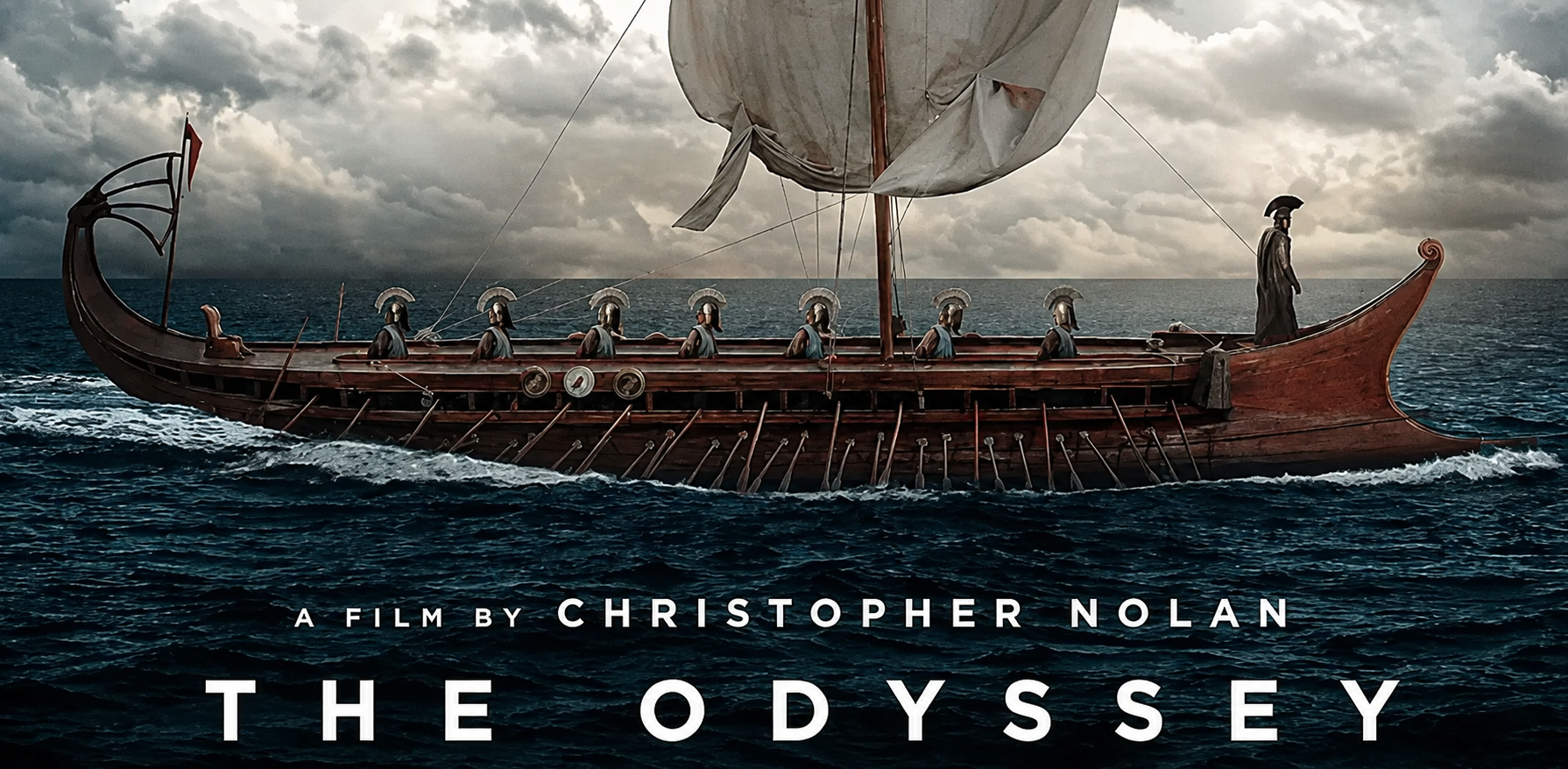
  • Christopher Nolan’s The Odyssey retells Homer’s ancient epic through the story of Odysseus, King of Ithaca.
  • After spending ten years fighting in the Trojan War, Odysseus attempts to return home to his wife Penelope and son Telemachus.
  • His journey home becomes a long series of physical, psychological and supernatural trials.
    • The Odyssey is more than an adventure about travelling home.
    • It explores:
      • War and its consequences
      • Identity
      • Memory
      • Guilt and responsibility
      • Family and loyalty
      • The meaning of home
    • Its central question is whether Odysseus can truly return to the person and life he left behind after everything he has experienced.
 

Odyssey as a Spiritual Journey


What Is Zeus’ Law?

  • One of the film’s important themes is Zeus’ Law, associated with the Greek concept of xenia.
  • Xenia represents the sacred relationship between host and stranger.
  • Travellers should be treated with hospitality and protection.
  • Guests, in return, should respect their hosts.
  • The film repeatedly explores what happens when trust, hospitality and moral order are violated.


What Does the Cyclops Represent Spiritually?

  • The fact that Odysseus and his crew follow the sheep into the Cyclops’ cave is especially significant.
  • The sheep represent instinctive, habitual consciousness — appetite, comfort, herd behaviour and the ordinary drives of the lower nature. They are not evil; they are simply unconscious.
  • By following the sheep into the cave, Odysseus symbolically follows these natural impulses downward into the hidden regions of the psyche.
  • The cave represents the unconscious, where primitive forces and instinctive patterns normally remain unseen.
  • The Cyclops’ single eye represents consciousness restricted to one viewpoint — powerful, self-centred and unable to perceive a wider reality.
  • His life among the sheep suggests that the ego is closely connected with instinct, organising natural desires into a personal identity based around my needs, my possessions, my territory and my desires.
  • Significantly, the sheep eventually become the means of escape. Odysseus and his men conceal themselves beneath them and use the very instincts that led them inward to find their way back out.
  • This creates an important spiritual reversal:Unconscious instinct → descent into the cave → confrontation with ego → conscious use of instinct → liberation.
  • The lesson is therefore not that instinct must be destroyed. Rather, the lower nature must be understood, integrated and brought beneath conscious spiritual direction.


Esoteric Key:
The sheep represent the instinctive lower nature, while the Cyclops represents the one-eyed ego that governs and depends upon it. Odysseus initially follows instinct unconsciously into the cave, but later uses those same instincts consciously to escape. Spiritual development therefore does not require the destruction of the lower nature, but its understanding, integration and direction by a higher awareness.

Trial 4: The Laestrygonians

What Happens During the Laestrygonians Episode in Nolan’s Film?

  • After escaping the Cyclops, Odysseus and his men land on another island seeking food, shelter and safety.
  • While exploring the forest, they encounter an enormous child.
  • The child gives a piercing scream, summoning the Laestrygonians.
  • The Laestrygonians appear as towering, heavily armoured giants and launch a devastating attack.
  • The surrounding forest seems almost to close around the Greeks, increasing their sense of entrapment.
  • Odysseus and his men are forced into a desperate retreat towards the shoreline.
  • Many of the Greeks are killed as they attempt to reach their ships.
  • The Laestrygonians destroy almost all of Odysseus’s remaining fleet.
  • Only one ship, carrying Odysseus and a small number of survivors, manages to escape.
  • The encounter strips Odysseus of much of the military strength and outward power with which he left Troy.

Circe — A Spiritual Interlude

Circe functions as a threshold figure in Odysseus’s journey. She stands between the more outward ordeals of the voyage and the deeper inner descent that follows. Her encounter exposes the danger of consciousness becoming absorbed in the lower nature, while also preparing Odysseus for the movement toward the Underworld

What Does Circe Represent Spiritually?

  • Circe transforms Odysseus’s companions into animals, providing a powerful image of human consciousness becoming dominated by its instinctive nature.
  • The human being contains both higher awareness and animal impulses. When appetite, desire and unconscious habit become dominant, consciousness is symbolically reduced to the level of instinct.
  • Circe therefore represents the enchantment of the lower nature — the tendency for consciousness to lose its higher perspective when absorbed by desire, pleasure or habitual behaviour.
  • The transformation of the crew suggests that the lower nature does not simply influence consciousness; if left unchecked, it can begin to determine identity itself.
  • Odysseus resisting Circe’s influence represents the seeker becoming sufficiently aware to recognise instinct without becoming completely identified with it.
  • Spiritually, the lesson is not to suppress or destroy the animal nature, but to restore the correct relationship between higher awareness and instinct.
  • Circe also serves as a transitional figure. Having exposed the danger of identification with the lower nature, she redirects Odysseus toward the deeper inner confrontation of the Underworld.

Esoteric Key:

Circe represents the enchantment of the lower nature, where appetite, desire and unconscious habit can reduce consciousness to instinctive behaviour. Odysseus’s resistance symbolises the growing ability to recognise these forces without becoming identified with them. As a spiritual interlude, Circe also marks a threshold: the journey is beginning to move from outer conflict towards deeper inner confrontation.


Trial 5: The Trial of the Underworld (Hades)

What Happens in Nolan’s Underworld Sequence?

  • Circe directs Odysseus toward the realm of the dead as part of his journey.
  • Odysseus performs a blood ritual or sacrifice to summon the dead.
  • Hades appears as a strange black or ashen shoreline, rather than a conventional underground realm.
  • The dead begin to emerge almost from the earth itself, with hands and shrouded figures rising through the dark ground.
  • Odysseus encounters Tiresias, the blind prophet, who reveals what lies ahead on his journey.
  • He also encounters Agamemnon.
  • Most significantly in Nolan’s version, Odysseus confronts Sinon, the young Greek sacrificed as part of the Trojan Horse deception.
  • Sinon forces Odysseus to confront the human cost of his cleverness and his actions at Troy.
  • The shades of the fallen increasingly surround him, including the threatening presence of dead Trojans.
  • After receiving Tiresias’s warning, Odysseus withdraws and continues his journey toward Scylla and Charybdis.

What Is the Esoteric Meaning of Odysseus Entering the Underworld?

  • The Underworld represents a descent beneath the conscious personality into unresolved areas of the psyche that cannot simply be escaped by moving forward in life.
  • Odysseus has physically left Troy behind, but Hades reveals that physical departure is not the same as inner release. What has not been understood or integrated continues to accompany consciousness.
  • The dead can therefore be understood as living impressions within the soul — unresolved actions, relationships and consequences that still carry psychological and spiritual energy.
  • In this sense, Hades becomes a karmic mirror. Karma is not presented simply as punishment, but as the return of experience to consciousness: what we create eventually asks to be recognised.
  • Sinon is especially important because he exposes the shadow within Odysseus’s celebrated intelligence. The Trojan Horse achieved victory, but another person bore part of its cost.
  • Odysseus can therefore no longer maintain a simple image of himself as victorious, courageous or justified. He must recognise that light and shadow can coexist within the same individual.
  • The descent marks a movement from self-justification toward self-knowledge. Genuine spiritual development requires the seeker to see not only their virtues, but also the consequences they would prefer not to acknowledge.
  • The dead rising from the ground symbolise the contents of the unconscious becoming conscious. What has been buried begins to emerge when consciousness is finally capable of facing it.
  • Tiresias introduces another dimension. While the other shades draw Odysseus toward his past, Tiresias points toward his future. The seeker must understand what lies behind before clearer direction can emerge about what lies ahead.
  • Hades therefore represents the ancient initiatory pattern of descent before ascent. Odysseus enters darkness not because darkness is his destination, but because something must be retrieved from it — truth, responsibility and deeper self-knowledge.
  • He is not being asked to remain imprisoned by guilt. Spiritually, the task is to transform guilt into consciousness, so that the past can be understood rather than unconsciously repeated.
  • The Underworld therefore becomes a place of reckoning, integration and release. Odysseus cannot fully return to Ithaca — the inner spiritual centre — while important parts of his own history remain unacknowledged.


Esoteric Key:
The Underworld represents the soul’s necessary descent into its unresolved past. What has been denied, buried or left behind must eventually rise into consciousness — not simply to punish us, but to be recognised, understood and integrated. Hades teaches that genuine ascent requires descent first: only by bringing awareness into the hidden parts of ourselves can consciousness continue its journey toward its true inner Home.


Trial 9: The Destruction of the Final Ship & Crew


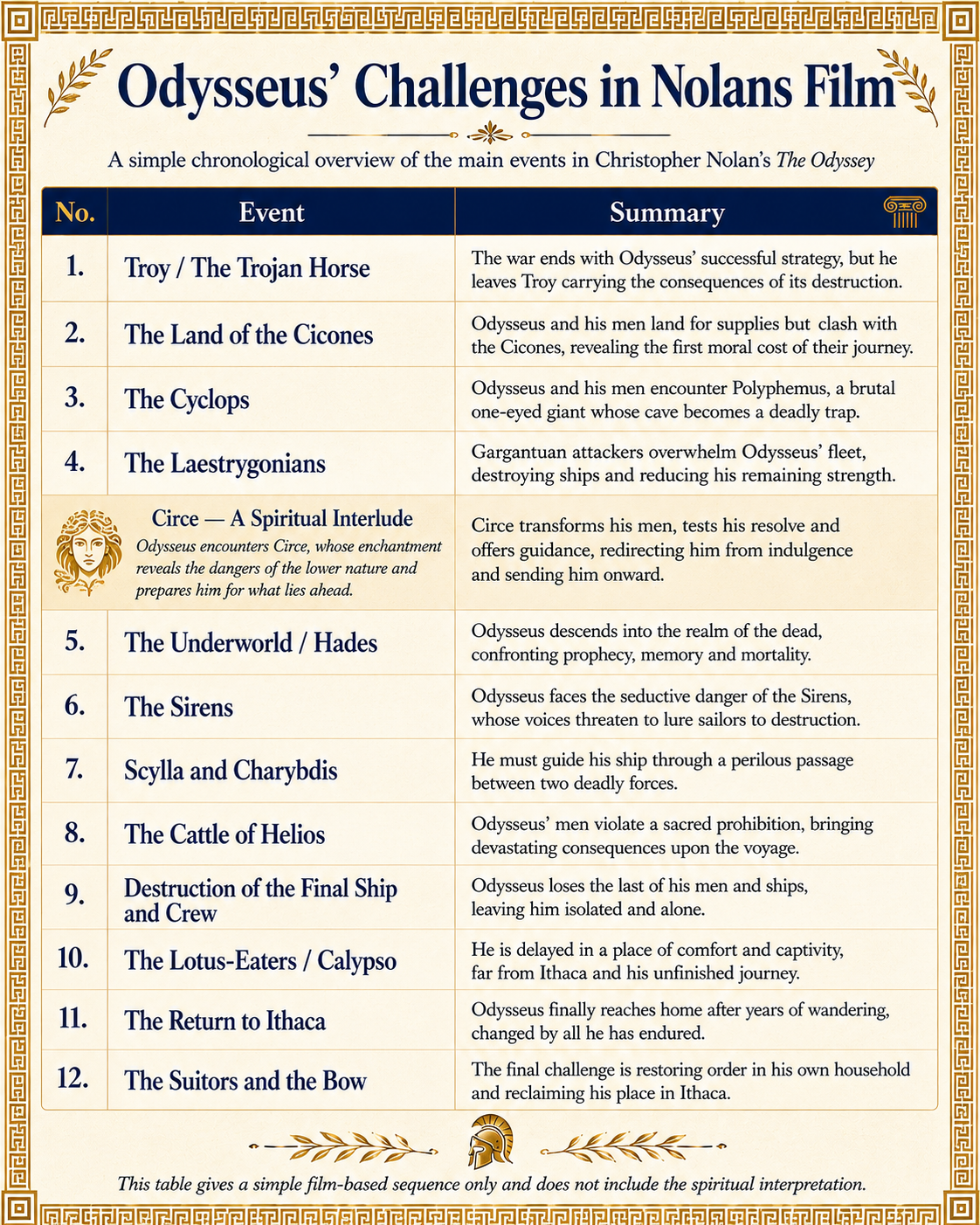
Summary of the Twelve Trials of Odysseus

Odyssey as a Spiritual Journey


Meditation & Esoteric Projects

Christopher Nolan’s Odyssey: Twelve Trials of Consciousness

Leave a Reply

Your email address will not be published. Required fields are marked *