B.O.T.A. Tarot Deck and Rider-Waite Comparison
B.O.T.A., from which the B.O.T.A. Tarot Deck takes its name, stands for Builders of the Adytum. Founded by Paul Foster Case in 1922, B.O.T.A. describes itself as a Mystery School and training order working within the Western Mystery tradition. Its teachings bring together Tarot, Qabalah, astrology, alchemy, meditation and spiritual psychology as parts of a structured path of inner development.
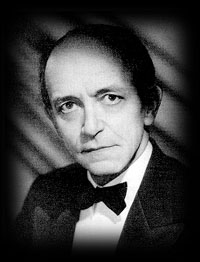
Paul Foster Case was born on October 3, 1884, and died on March 2, 1954. He began studying Tarot at a young age and eventually became one of the most influential modern teachers of the relationship between Tarot and the Holy Qabalah. For Case, Tarot was not merely a system of fortune-telling.
It was a symbolic language through which the student could investigate consciousness, understand universal principles and gradually awaken to the Higher Self.
What Does “Adytum” Mean?
The word Adytum is derived from a Greek term referring to the innermost sanctuary of a temple—the Inner Shrine or Holy of Holies. In the ancient world, this was the most sacred part of the temple, accessible only to those who were properly prepared.
Within B.O.T.A., however, the Adytum is not understood merely as a physical chamber. It represents the inner spiritual sanctuary that must be constructed within the consciousness of the aspirant. The name Builders of the Adytum therefore expresses the central purpose of the school:
to help the student build an inner temple in which conscious contact with the Higher Self may take place.
This gives the name a practical rather than merely philosophical significance. The student is the builder, the personality is the field of construction, and the awakened consciousness is the sanctuary being prepared.
Who Created the B.O.T.A. Tarot Deck?
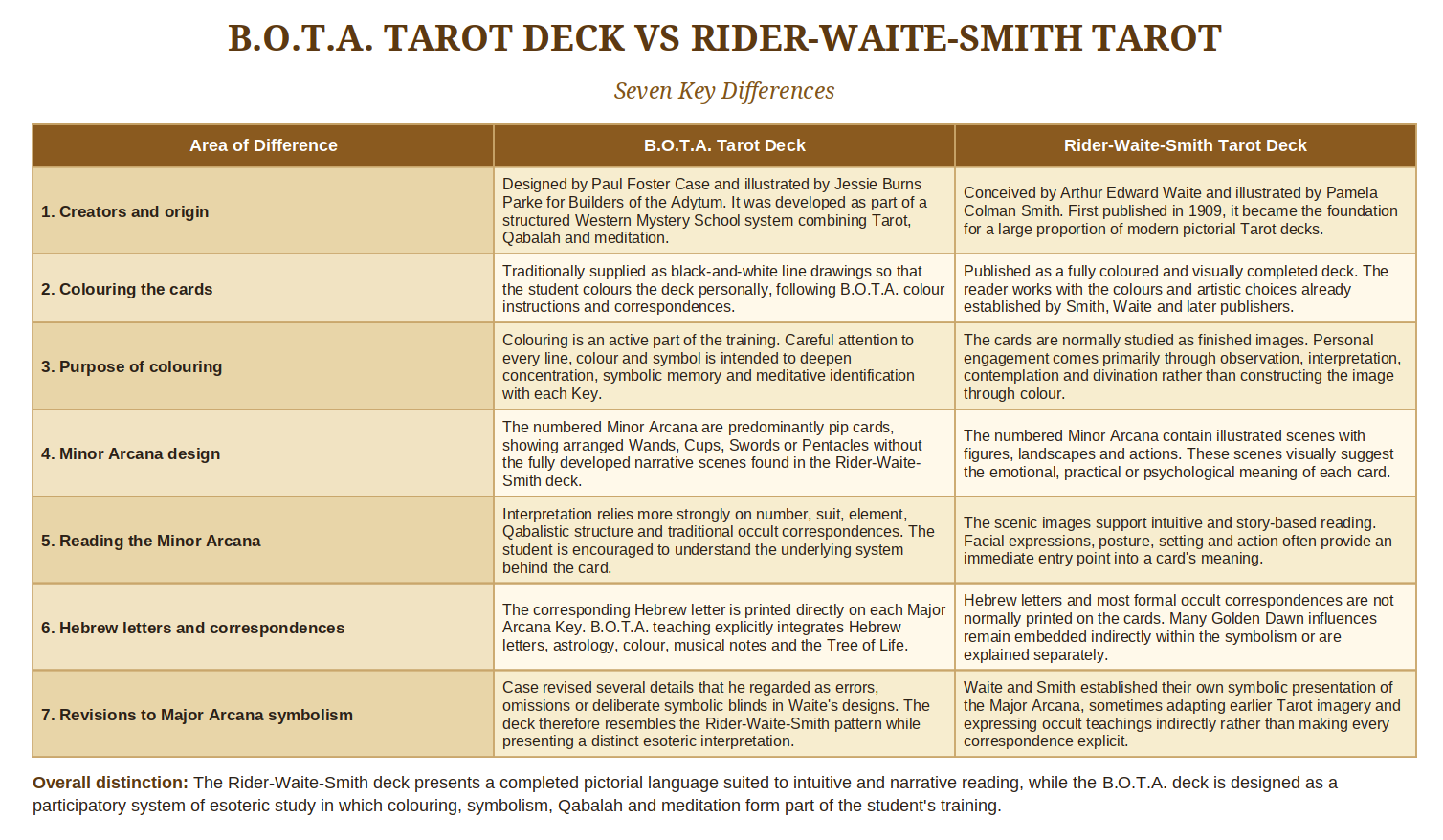
The B.O.T.A. Tarot Deck was designed under the direction of Paul Foster Case, with its illustrations produced by the artist Jessie Burns Parke. Its imagery bears a clear resemblance to the Rider–Waite–Smith Tarot, created by Arthur Edward Waite and illustrated by Pamela Colman Smith.
Case openly acknowledged this visual similarity. He believed that Parke had followed Pamela Colman Smith’s artistic style rather more closely than he had originally intended. Nevertheless, he was satisfied with the completed deck because the symbols had been altered or clarified according to his own understanding of the Western Mystery tradition.
The B.O.T.A. deck should therefore not be regarded simply as a copy of the Rider–Waite–Smith deck. Although the two decks share a recognisable visual ancestry, they differ in their intentions. Waite created a deck containing many layers of concealed esoteric symbolism, whereas Case wanted the Tarot Keys to function as a more precise system of spiritual instruction.
What are the Key Differences between the B.O.T.A & Rider-Waite Tarot Decks
Why Did Paul Foster Case Create Another Tarot Deck?
In The Tarot: A Key to the Wisdom of the Ages, Case explains why he believed a revised Tarot deck was necessary.
His principal objection was that Waite had, in Case’s view, deliberately obscured or omitted certain symbolic details. These omissions acted as esoteric “blinds”—devices traditionally used to conceal aspects of occult teaching from readers who had not received the corresponding oral or initiatory instruction.
Case also believed that Waite had changed certain cards to reflect his personal interpretations, sometimes moving them too far away from what Case regarded as their older and more authentic meaning.
These criticisms should be understood as Case’s interpretation of the Tarot tradition, rather than as an objective dismissal of Waite’s achievement. The Rider–Waite–Smith deck remains profoundly symbolic. Case’s concern was that its symbolism did not always express the Qabalistic and Hermetic correspondences as directly as he wished.
His aim was therefore not to remove mystery from the Tarot, but to remove unnecessary confusion. Mystery would remain because the deepest meaning of a symbol cannot simply be explained in words. It must eventually be realised within consciousness.
A Tarot Deck Without “Blinds”
Case summarised the intention behind his version when he wrote:
“No ‘blinds’ in this version, and every symbol is intended to mean just what it is said to signify in the explanations.”
This is an important statement because it reveals how Case understood the function of the deck. Every line, object, gesture, number, colour and geometrical form was intended to communicate a specific principle.
The symbols were not included merely to create an attractive or mysterious atmosphere. They formed a carefully organised language connecting the Tarot with:
- the twenty-two Hebrew letters;
- the paths of the Qabalistic Tree of Life;
- astrology and the seven classical planets;
- the four elements;
- number symbolism;
- spiritual psychology;
- meditation and inner transformation.
The B.O.T.A. Tarot is therefore best approached as a series of symbolic diagrams. Each Key presents a particular pattern of consciousness. Studied individually, the cards reveal distinct spiritual principles; studied together, they form a map of the soul’s development.
Tarot as a Tool for Spiritual Transformation
B.O.T.A. teaches that the principal purpose of Tarot is not ordinary prediction. Its deeper purpose lies in study, meditation, imagery and the transformation of consciousness. The images communicate through symbols, and symbols can reach levels of the mind that are not always accessible through intellectual analysis alone.
The Tarot Keys may consequently be regarded as mirrors of consciousness. They depict universal powers, but those powers also operate within the individual.
The Magician, for example, is not merely a character standing before a table. He represents focused attention, conscious direction and the ability to transmit spiritual power into practical activity. The High Priestess represents memory, receptivity and the deeper subconscious field. The Fool represents the limitless spiritual Life from which all manifestation arises.
Through prolonged study, the figures gradually cease to appear as distant mythological characters. They become recognisable as living principles within the student.
Why Must the Student Colour the B.O.T.A. Tarot?
One of the most distinctive features of the B.O.T.A. system is its emphasis on colouring the Tarot Keys personally.
Paul Foster Case strongly believed that students should colour their own cards rather than receive a completely coloured deck. The original Keys were therefore supplied as black-and-white line drawings. This was not simply a cost-saving measure or an artistic novelty. The act of colouring was itself part of the spiritual training.
Colouring requires the student to slow down and examine every detail. A symbol that might otherwise be overlooked must be considered carefully before colour is applied. The eye begins to recognise relationships between shapes, gestures, colours and background details.
The student is no longer merely looking at a finished Tarot card. Through sustained attention, they participate in bringing the image into manifestation.
Colour also has a psychological and meditative function within the B.O.T.A. tradition. Specific colours correspond to particular planets, elements and states of consciousness. Applying those colours helps impress the associated ideas upon the subconscious mind. B.O.T.A. itself describes colour and sound as practical instruments for balancing the personality and supporting spiritual unfoldment.
Colouring as Meditation
Colouring a Tarot Key can become a simple form of meditation. Attention rests upon the image, the hand becomes steady, and the ordinary movement of thought begins to quieten.
The purpose is not to produce a perfectly coloured artistic object. The value lies in the quality of attention brought to the process.
As each area of the card is coloured, questions naturally arise:
- Why is this object placed here?
- Why is this colour associated with this symbol?
- What relationship exists between the central figure and the surrounding landscape?
- What inner quality does the image awaken?
- Where does this same principle operate within my own consciousness?
These questions do not always require immediate verbal answers. Sometimes the meaning of a Tarot Key matures gradually through repeated observation.
A Buddhi Perspective: From Symbol to Direct Recognition
From a Buddhi perspective, the Tarot is not merely a collection of symbols that must be mentally decoded. Intellectual study provides a necessary foundation, but the deeper purpose is to purify perception until the central truth of a Key is recognised directly.
Buddhi does not produce more complicated thought. It brings coherence, quiet certainty and an intuitive perception of the whole.
When studying a Tarot Key, the analytical mind may examine every separate detail: the Hebrew letter, the colour, the number, the planetary attribution and the position of the figure. Buddhi begins to operate when these separate correspondences are suddenly perceived as expressions of one underlying principle.
The card is then no longer a collection of fragments. It becomes a unified field of meaning.
This recognition should not be forced. There is no need to hunt for visions or invent hidden messages. The student studies carefully, colours attentively and then allows the image to rest within consciousness. Insight may emerge as a simple sense of wholeness or as a meaning that is present before it can be expressed in words.
In this way, the Tarot Key becomes a meeting place between knowledge and direct perception.
My Self-Colouring B.O.T.A. Tarot Series
As part of this in-depth B.O.T.A. Tarot series, I will be colouring my own edition of the cards as I progress through the deck.
Each presentation will examine the principal symbols, colour correspondences, Qabalistic associations and spiritual meaning of the individual Key. The colouring process will form an important part of the study, allowing the symbolism to unfold slowly rather than approaching the cards only as completed images.
This creates a more personal and immersive relationship with the deck. Every colour must be consciously selected and applied, encouraging closer observation of details that might otherwise remain unnoticed.
The completed cards will therefore represent more than an artistic project. Together, they will record a gradual journey through the symbolic and spiritual teachings of the B.O.T.A. Tarot.
The B.O.T.A. Tarot as an Inner Journey
The B.O.T.A. Tarot begins with printed lines on an uncoloured card, but its real completion takes place within the student.
As the images are studied and coloured, the outer deck becomes increasingly familiar. At the same time, the inner principles represented by the cards begin to awaken within consciousness.
The ultimate Adytum is not found inside an organisation, a book or a pack of Tarot cards. It is the sanctuary of awakened awareness within the individual. The Tarot Keys provide the plans, colours and symbolic measurements, but the inner temple must be built through personal study, meditation and direct experience.
The student colours the cards, but the deeper purpose of the work is that the cards gradually colour—and transform—the consciousness of the student.
Amazon Links
- Paul Foser Case: His Life and Works
- The Tarot: A Key to the Wisdom of the Ages
- Tarot Interpretations: Advanced Practices in Tarot Meditation, Magic Squares, and Kabbalistic Symbolism
