Heraclitus: Fire, Flux and the Hidden Logos
Who Was Heraclitus?
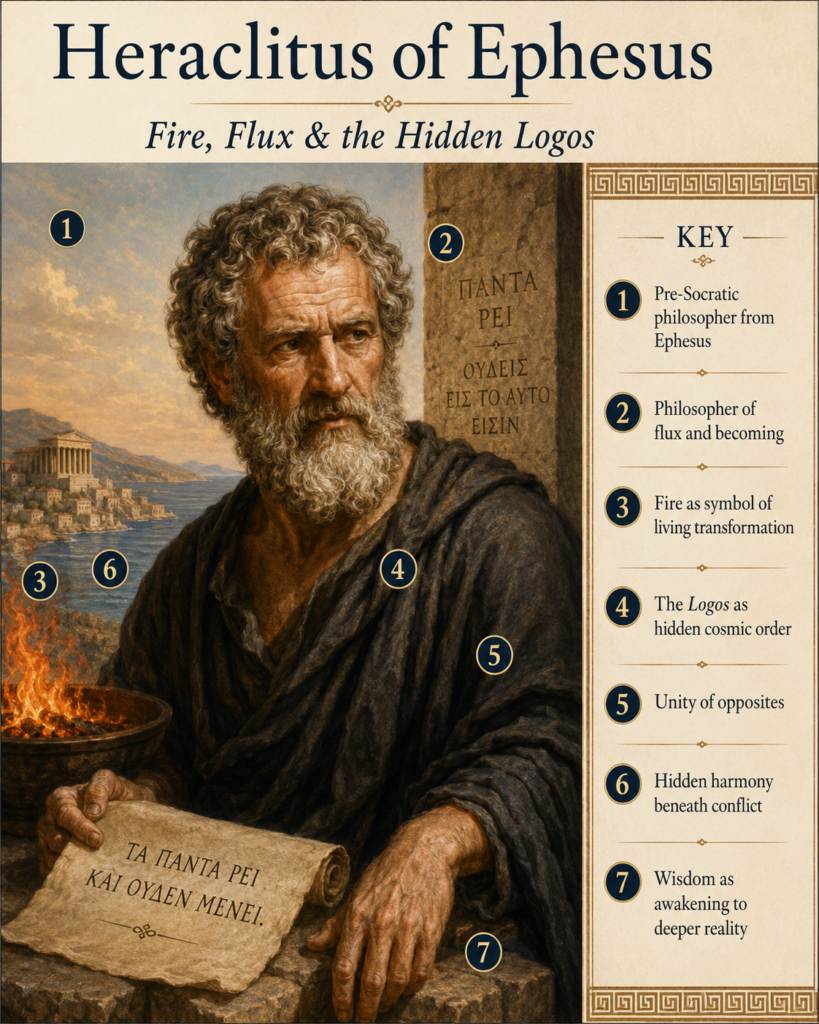
- Heraclitus was a pre-Socratic Greek philosopher
- He came from Ephesus
- He lived around c. 540–480 BCE
- He is one of the most important early philosophers in Western thought
- He is known for his teachings on:
- change
- fire
- the unity of opposites
- the Logos
- His philosophy explores the hidden order behind the movement of life
What Is Heraclitus Best Known For?
- Heraclitus is best known as the philosopher of flux
- He taught that reality is not fixed or static
- He saw existence as:
- living
- moving
- changing
- becoming
- For Heraclitus, the world is not dead matter but a dynamic process
- Yet this process is not chaotic
- Beneath change lies a deeper order
Why Did Heraclitus Use Fire as a Symbol?
- Fire is Heraclitus’ great cosmic symbol
- Fire represents:
- movement
- transformation
- living energy
- continual exchange
- Fire is never static
- It shows that reality is always becoming
- Fire also suggests measure and rhythm
- It symbolises a cosmos that is both dynamic and ordered
- For Heraclitus, fire expresses the living nature of existence
What Did Heraclitus Mean by Flux?
- Flux means constant change
- Heraclitus saw the world as always:
- shifting
- transforming
- unfolding
- Nothing in the visible world remains permanently the same
- Human life, nature, and the cosmos all participate in this movement
- This teaching reminds us that outer forms cannot provide lasting permanence
- To cling to changing things as though they were unchanging is to misunderstand life

What Is the Logos in Heraclitus?
- The Logos is the hidden order behind the cosmos
- It is the inner principle of:
- intelligence
- law
- proportion
- meaning
- The Logos makes the world intelligible rather than random
- It is the deeper pattern within the flow of change
- Heraclitus suggests that most people do not recognise this hidden order
- Wisdom begins when one awakens to the Logos
Why Is the Logos Important in Heraclitus’ Philosophy?
- The Logos explains how constant change can still belong to a meaningful universe
- It shows that movement and transformation are governed by a deeper law
- It reveals that reality has:
- measure
- coherence
- hidden intelligence
- Without the Logos, change would appear to be disorder
- With the Logos, change becomes part of a deeper harmony

What Did Heraclitus Mean by the Unity of Opposites?
- Heraclitus taught that opposites belong together within a greater whole
- Examples of opposites include:
- day and night
- life and death
- ascent and descent
- tension and release
- Opposites are not merely enemies
- They exist in relation to one another
- Their tension is part of the structure of reality
- What appears divided outwardly may be inwardly united
- Hidden harmony often lies beneath visible contradiction
What Does He Teach About Human Awareness?
- Heraclitus suggests that most people live on the surface of life
- They see appearances, but not the deeper order behind them
- They notice change, but not the law within change
- Wisdom requires awakening to the hidden pattern of existence
- Philosophy becomes a path of deeper seeing
- The wise person learns to perceive the Logos behind appearances
How is his philosophy Related to the Path of Light and Sound?
- Heraclitus can be related to the path of Light and Sound because he points beyond surface appearances to a deeper living reality
- The outer world is always changing
- Forms rise and pass away
- Nothing in the visible realm offers final permanence
- This becomes a spiritual lesson for the seeker
- The soul must look beyond outer change toward the deeper principle behind life
- Heraclitus’ Logos can be read mystically as:
- hidden harmony
- divine intelligence
- sacred order
- the inner law within creation
- In the path of Light and Sound, this may be understood as the deeper spiritual current behind manifestation
- It is the inward stream of divine life to which the soul gradually awakens
- Heraclitus also teaches that most people remain asleep to deeper reality
- They live among surfaces, names, and passing forms
- In a similar way, Light and Sound meditation calls the seeker inward
- It invites a movement from:
- outer distraction
- surface consciousness
- restless mental activity
- toward:
- inner stillness
- spiritual perception
- direct receptivity
- As meditation deepens:
- the mind grows quieter
- the soul becomes more inwardly awake
- a hidden order begins to be sensed
- Beneath the restless flow of life, there is a deeper harmony
- Beneath outward change, there is a sacred current
- Beneath visible conflict, there is living unity
- In this sense, Heraclitus may be read as a philosopher of inner awakening
- His teaching reminds the seeker that:
- the visible world is not the whole
- change is not the final truth
- hidden harmony lies behind appearances
- The soul must learn to hear, see, and know that deeper reality within
Light and Sound Meditation Links



Meditation & Esoteric Projects
Heraclitus: Fire, Flux and the Hidden Logos