What is Mormonism and its relationship to the Spiritual Path ?
Introduction to What is Mormonism
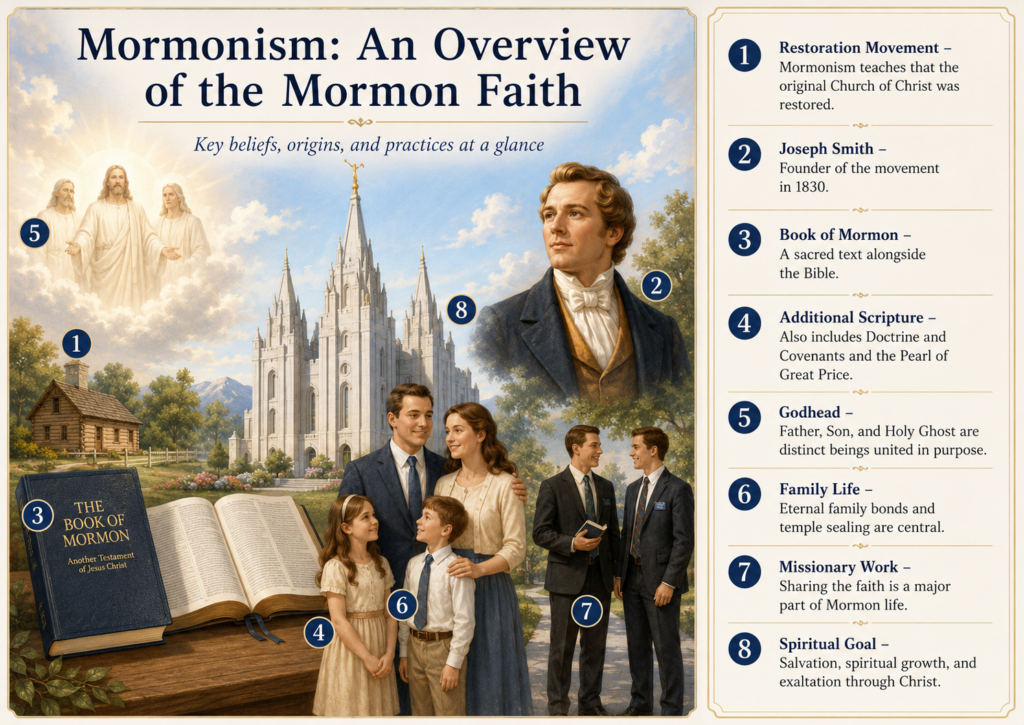
What Is Mormonism? Mormonism is a modern Christian restorationist faith that began in nineteenth-century America through the teachings of Joseph Smith. This overview explores the origins, beliefs, practices, and spiritual meaning of the Mormon faith, while also considering how its emphasis on revelation, discipline, and the soul’s return to God relates to the wider spiritual path.
- Mormonism is a modern religious movement that began in nineteenth-century America.
- Its largest body today is The Church of Jesus Christ of Latter-day Saints, often called the LDS Church.
- Members are often known as Mormons, although the church itself prefers the term Latter-day Saints.
- Mormonism is centred on:
- Jesus Christ
- scripture
- family life
- moral discipline
- missionary work
- continuing revelation
- spiritual progression
What Is Mormonism?
- Mormonism teaches that the original Church established by Jesus Christ was lost or corrupted after the age of the apostles.
- It claims that this lost Church needed to be restored, not merely reformed.
- This makes Mormonism a Restorationist religious movement.
- A restorationist faith means a religion that believes the original, pure form of Christianity was lost, weakened, or corrupted over time, and therefore needed to be restored by divine intervention.
- Latter-day Saints believe that Joseph Smith was chosen by God to restore:
- true doctrine
- priesthood authority
- sacred ordinances
- prophetic leadership
- additional scripture
Who Was Joseph Smith?
- Joseph Smith (December 23, 1805, to June 27, 1844) was the founder of the Mormon movement.
- He was born in 1805 in Vermont, USA.
- He lived during a period of intense Christian revival known as the Second Great Awakening.
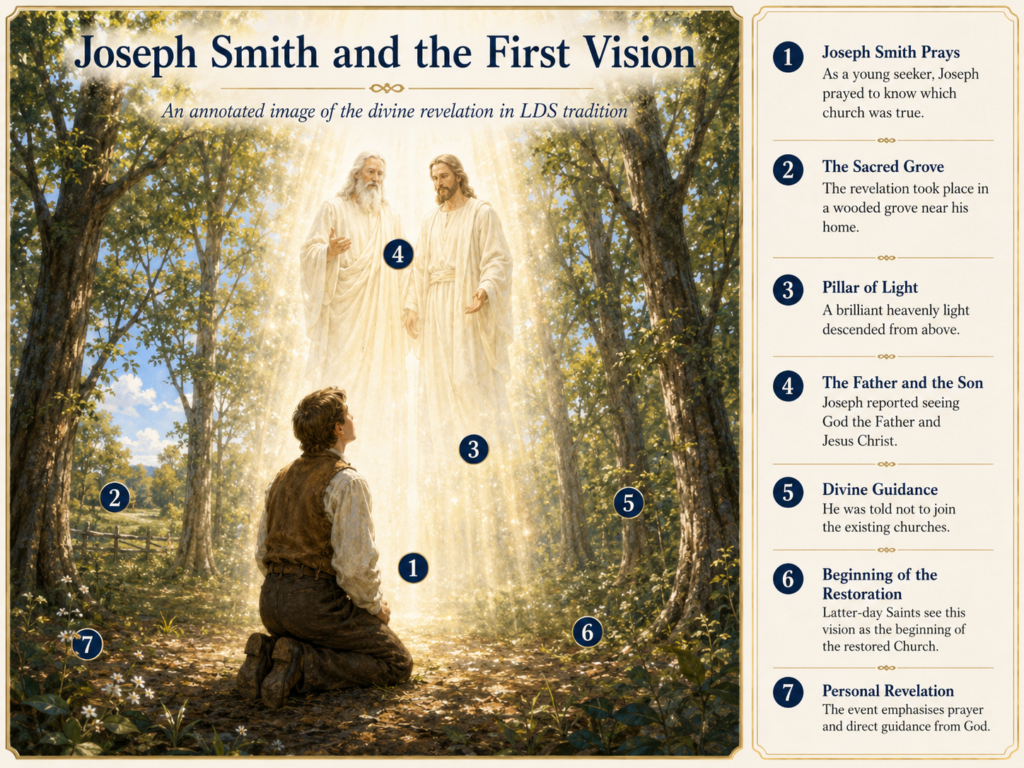
- According to Mormon belief, Smith was confused by the many different Christian churches around him.
- He prayed to know which church was true.
- Latter-day Saints believe that he received a vision of God the Father and Jesus Christ.
- This event is known as the First Vision.
- In this vision, Joseph Smith was told that the fullness of the true Church was not then present on earth.
- This became the foundation of the Mormon belief in a restored Church.
How Did the Mormon Church Begin?
- The Mormon Church formally began in 1830 in New York State.
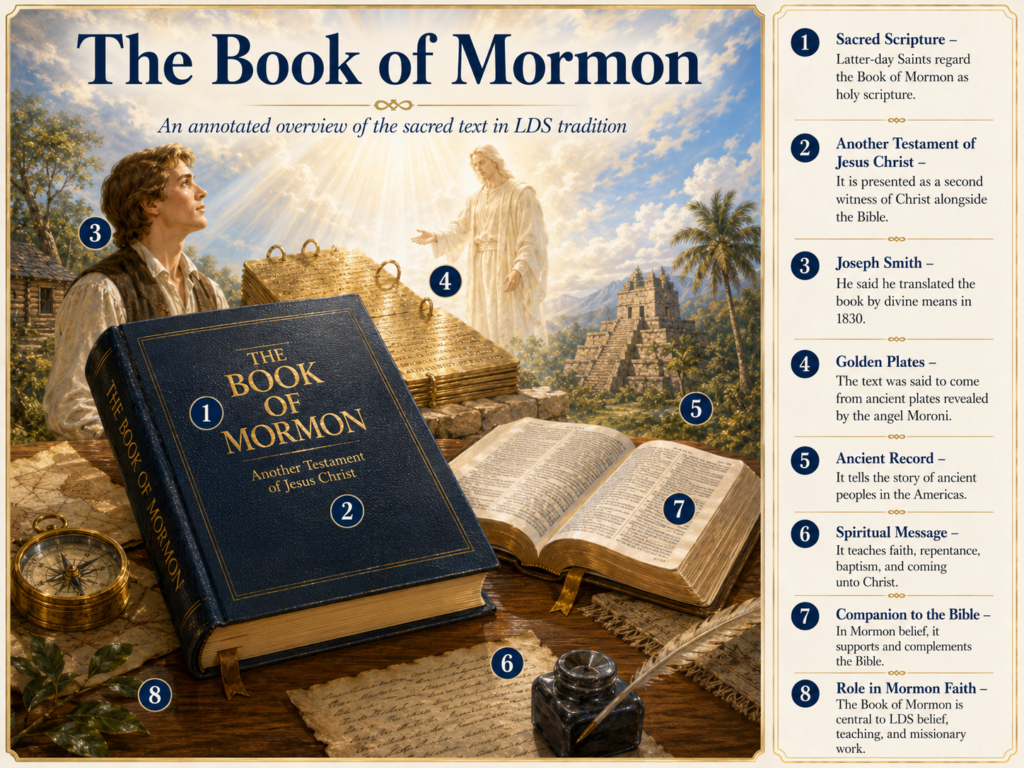
- In the same year, Joseph Smith published the Book of Mormon.
- He said he translated it by divine power from ancient golden plates.
- The book was presented as a sacred record of ancient peoples who had lived in the Americas.
- Early Mormons faced strong opposition and persecution.
- They moved from:
- New York
- Ohio
- Missouri
- Illinois
- eventually to Utah
- After Joseph Smith was killed in 1844, most Latter-day Saints followed Brigham Young westward.
- This migration helped shape Mormonism’s strong sense of:
- community
- sacrifice
- pilgrimage
- divine mission
What Is the Book of Mormon?
- The Book of Mormon is one of the central scriptures of the Mormon faith.
- Latter-day Saints regard it as another testament of Jesus Christ.
- It is used alongside the Bible.
- It tells the story of ancient peoples in the Americas.
- Its central message is that Jesus Christ is the Saviour of the world.
- It teaches the importance of:
- faith
- repentance
- baptism
- obedience to God
- spiritual transformation
- Mainstream Christianity does not accept the Book of Mormon as scripture.
- For Latter-day Saints, however, it is a sacred witness that God has spoken beyond the biblical world.
What Scriptures Do Mormons Use?
- Latter-day Saints accept the Bible as scripture.
- They also accept additional sacred texts.
- Their main scriptures are:
- The Bible
- The Book of Mormon
- Doctrine and Covenants
- The Pearl of Great Price
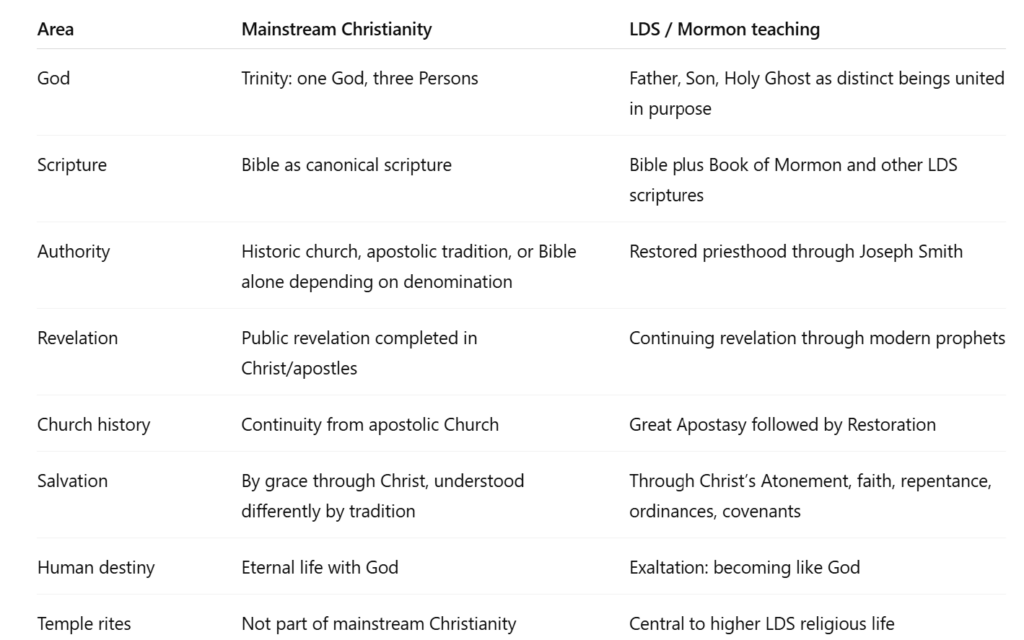
- This is one of the major differences between Mormonism and mainstream Christianity.
- Most mainstream Christians accept the Bible as the completed canon of scripture.
- Mormons believe that God continues to reveal truth and that scripture can expand through revelation.
What Do Mormons Believe About God?
- Mormons believe in:
- God the Father
- Jesus Christ
- the Holy Ghost
- However, their understanding differs from the traditional Christian doctrine of the Trinity.
- Mainstream Christianity usually teaches that the Father, Son, and Holy Spirit are three Persons within one divine Being.
- Latter-day Saints believe that the Father, Son, and Holy Ghost are distinct beings.
- They are seen as perfectly united in:
- will
- love
- purpose
- divine intention
- Mormons usually refer to this as the Godhead rather than the Trinity.
- This is one of the main reasons why many mainstream Christian churches regard Mormonism as outside traditional Nicene Christianity.
What Do Mormons Believe About Jesus Christ?
- Jesus Christ is central to Mormon belief.
- Latter-day Saints believe that Jesus is:
- the Son of God
- the Saviour
- the Redeemer of humanity
- the risen Lord
- They believe in His:
- birth
- ministry
- crucifixion
- resurrection
- atoning sacrifice
- Mormons believe that through Christ’s Atonement, human beings can:
- repent
- be forgiven
- overcome sin
- overcome death
- return to God
- Mormonism also emphasises:
- ordinances
- covenants
- obedience
- moral discipline
- spiritual progression
What Is the Mormon View of Salvation?
- Mormons believe that salvation comes through Jesus Christ.
- They teach that without Christ’s Atonement, humanity could not overcome sin or death.
- Mormonism also teaches that human beings existed as spirit children of God before birth.
- Earthly life is seen as part of a divine plan of growth and testing.
- The highest spiritual goal is often called exaltation.
- Exaltation means:
- returning to God
- becoming like God
- living eternally in divine family relationships
- This differs from mainstream Christianity.
- Most mainstream Christian traditions describe salvation as eternal life with God, not progression toward godlike exaltation.
Why Is Family So Important in Mormonism?
- Family is central to Mormon life and belief.
- Latter-day Saints believe that family relationships can continue beyond death.
- This belief is connected to the practice of temple sealing.
- Temple sealing joins husbands, wives, and families for eternity.
- The ideal is not simply “until death do us part.”
- Instead, Mormonism teaches the possibility of eternal family bonds.
- This gives the faith a strong emphasis on:
- marriage
- children
- ancestry
- genealogy
- family responsibility
- moral stability
What Happens in Mormon Temples?
- Mormon temples are different from ordinary church meeting houses.
- Weekly worship services are held in local chapels.
- Temples are reserved for special sacred ordinances.
- These include:
- eternal marriage
- family sealing
- proxy ordinances for the dead
- baptism for the dead
- Baptism for the dead means a living person is baptised on behalf of someone who has died.
- Latter-day Saints believe the deceased soul can then accept or reject that ordinance in the spirit world.
- This reflects the Mormon belief that God’s mercy extends beyond death.
- These temple practices are very different from mainstream Christianity.
Why Do Mormons Do Missionary Work?
- Missionary work is a major part of Mormon identity.
- Many young Latter-day Saints serve missions, often for around two years.
- Missionaries teach others about:
- Jesus Christ
- the Book of Mormon
- the restored gospel
- Joseph Smith
- the LDS Church
- Missionary work reflects the belief that the Church of Jesus Christ has been restored.
- It also expresses Mormon values of:
- service
- obedience
- discipline
- sacrifice
- religious commitment
How Does Mormonism Differ from Mainstream Christianity?
How Does Mormonism Relate to the Spiritual Search?
- Mormonism sees life as part of a divine plan.
- It teaches that human beings have a spiritual origin before birth.
- It presents earthly life as a place of testing, growth, and moral development.
- It teaches that the soul has an eternal destiny.
- It values revelation, divine guidance, and sacred commitment.
- These themes are found in many religious and esoteric traditions.
- Mormonism expresses them through:
- scripture
- prophets
- ordinances
- family life
- church structure
- covenant
- At its heart, Mormonism is concerned with the return of the soul to God.
How Does Mormonism Align With Our Spiritual Path?
- From the perspective of our own spiritual path, Mormonism can be appreciated for its emphasis on:
- divine revelation
- disciplined living
- service
- sacred purpose
- the soul’s return to God
- Its teaching that human life is part of a greater spiritual plan resonates with the view that incarnation is not accidental.
- It shares the idea that the soul is on a journey beyond the purely material world.
- Where our path may place more emphasis on:
- meditation
- inner experience
- Light and Sound
- direct spiritual ascent
- consciousness beyond the mind
- Mormonism expresses the journey through:
- faith
- covenant
- scripture
- community
- temple ordinance
- obedience to divine law
- The outer forms are different, but there is a shared aspiration.
- Both paths recognise that human life should be purified, purposeful, and directed towards the Divine.
- Both affirm that the soul’s true destiny lies beyond the material world and that the spiritual life requires commitment, transformation, and devotion.
UK Mormon Links

Meditation & Esoteric Projects
What is Mormonism and its Relationship to the Spiritual Path ?