Silent vs Spoken Mantra in Spiritual Practise
- Silent vs spoken mantra is a subtle but important distinction in spiritual practice.
- Both forms use sacred sound, yet they work in different ways within the body, mind, and inner awareness.
- Spoken mantra can help awaken energy, steady the breath, and strengthen concentration through vibration, while silent mantra often leads practice inward toward stillness, receptivity, and deeper absorption.
- Understanding how each operates can help the meditator choose the method most suited to their stage, temperament, and spiritual aim.
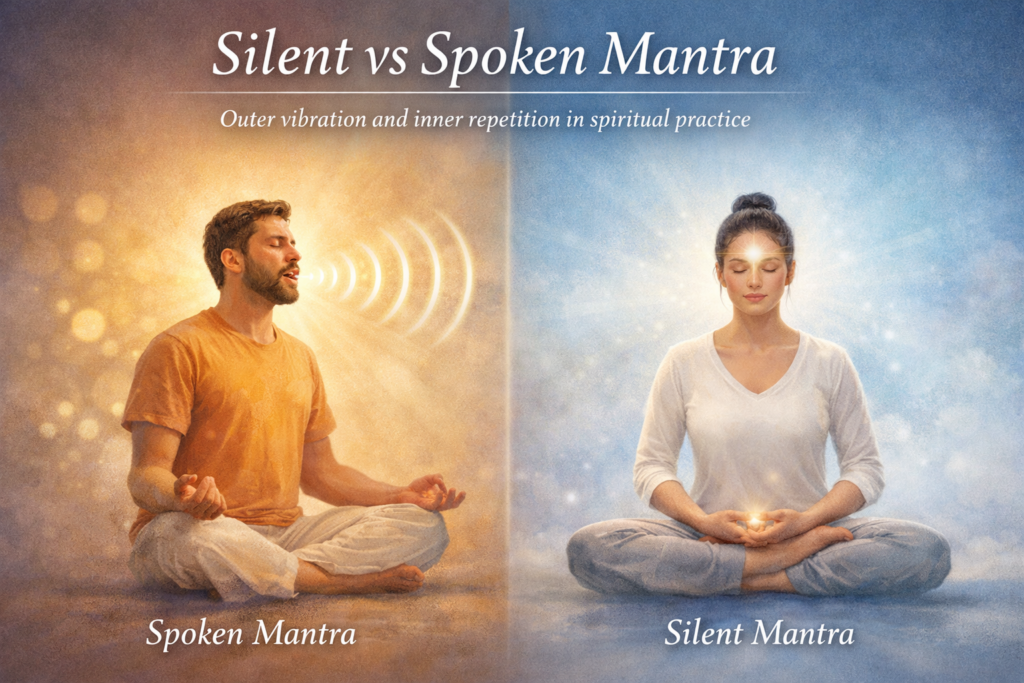
What is the difference between spoken and silent Mantra?
- Both spoken and silent mantra use repetition to gather the mind and direct awareness.
- The main difference is where the force of the practice is expressed.
- Spoken mantra works outwardly through breath, sound, rhythm, and audible vibration.
- Silent mantra works inwardly through attention, mental resonance, and subtle interior repetition.
- One is not necessarily superior in every case; each has its own function in practice.
- The value of either method depends on the stage of the meditator, the steadiness of concentration, and the aim of the practice.
How does spoken mantra work in meditation?
- Spoken mantra engages the body more directly through the vocal cords, breath, chest, throat, and nervous system.
- The audible sound can help stabilise wandering attention more easily than purely mental repetition.
- Rhythm and vibration often make the practice feel more immediate and tangible.
- Spoken mantra can create devotional warmth, energetic uplift, and stronger initial focus.
- It is often useful when the mind is restless, dull, sleepy, or scattered.
- For many beginners, spoken mantra is easier to sustain because it gives the mind a clear object to hold.
What are the strengths of spoken mantra?
- It helps gather dispersed energy into a single current of attention.
- It brings breath, sound, and awareness into one coordinated action.
- It can awaken enthusiasm and strengthen commitment to the practice.
- It may help purify emotion by replacing mental noise with a sacred rhythm.
- It gives a felt sense of vibration, which can support concentration in the early stages.
- It can be especially effective when used at the beginning of meditation to prepare the inner field.
What are the limitations of spoken mantra?
- Because it is outwardly expressed, it may keep awareness more tied to the physical level.
- Some practitioners may become attached to the sound itself rather than the consciousness behind it.
- Vocal repetition can sometimes stimulate rather than quieten the system.
- It may be less suitable when the aim is deep inward absorption or subtle listening.
- If done forcefully, it can produce strain in the throat, breath, or mind.
- It is most helpful when used with balance rather than mechanical repetition.
How does silent mantra work in meditation?
- Silent mantra shifts the practice from audible sound to inner repetition.
- The mantra is no longer spoken with the mouth but held in awareness.
- This draws attention away from the outer senses and toward the inner field of consciousness.
- Silent repetition often becomes more refined, more subtle, and less physically effortful.
- It can help the meditator move from mental activity toward stillness and receptivity.
- In deeper practice, the mantra may begin to feel as though it repeats itself rather than being actively produced.
What are the strengths of silent mantra?
- It encourages interiorisation and withdrawal from external distraction.
- It refines concentration beyond speech into subtler levels of awareness.
- It can lead more naturally toward silence, stillness, and inner listening.
- It is often better suited to meditative absorption than vocal repetition.
- It allows the practitioner to move from sound as action to sound as inner presence.
- In advanced use, silent mantra may become a bridge between thought and pure awareness.
What are the challenges of silent mantra?
- It can be more difficult for beginners because there is no audible sound to anchor attention.
- The mind may drift more easily into fantasy, sleep, or mechanical repetition.
- Without sufficient alertness, silent mantra may become vague or weak.
- Some practitioners think they are doing silent mantra when they are actually just daydreaming near the mantra.
- It requires greater precision of attention and sincerity of inward focus.
- For this reason, silent mantra often becomes strongest after some prior training in concentration.
Should mantra begin spoken and later become silent?
- In many cases, yes; this is a natural progression.
- Spoken mantra can collect the mind and awaken the current of practice.
- Whispered or very soft repetition can act as a bridge between outer and inner practice.
- Silent mantra can then carry the awareness into a deeper and more interior state.
- This movement from sound to silence mirrors the movement from effort to receptivity.
- Many practitioners find this graded approach both practical and spiritually balanced.
Is one method more powerful than the other?
- Power depends on context, not just technique.
- Spoken mantra may be more powerful when energy is low, the mind is distracted, or the heart needs warming.
- Silent mantra may be more powerful when concentration is stable and the aim is depth, stillness, and inner absorption.
- Spoken mantra tends to build and gather.
- Silent mantra tends to refine and deepen.
- The wisest approach is often to recognise the function of each rather than force a rigid preference.
Which form of mantra is more suited to the path of Light and Sound?
- For the path of Light and Sound, silent mantra is often the closer ally in the deeper stages of practice.
- This is because the path generally moves away from external activity and toward inner perception.
- Silent mantra harmonises with interior listening, subtle awareness, and the awakening of inner receptivity.
- It helps the practitioner turn from spoken vibration toward the hidden current of sound within.
- It also supports the transition from deliberate repetition to the spontaneous emergence of inner light and inner sound.
- Spoken mantra, however, still has an important preparatory role.
- It can steady the mind, purify emotion, and gather attention before the deeper inward movement begins.
- So within Light and Sound practice, spoken mantra may serve as preparation, while silent mantra may serve as the more natural vehicle of interior deepening.
- In that sense, spoken mantra helps the seeker approach the gate, while silent mantra more easily allows entry into the inner chamber.
What conclusion can be drawn about silent and spoken mantra?
- Spoken mantra and silent mantra are best understood as complementary rather than opposed.
- Spoken repetition can gather the energies, strengthen focus, and prepare the practitioner for meditation.
- Silent repetition can then carry awareness beyond outer vibration into subtler interior depths.
- For the seeker of Light and Sound, the silent form is often more closely aligned with inner listening and the awakening of the hidden current.
- Yet spoken mantra still has real value, especially in the earlier stages, when concentration must be established and the mind brought into one stream.
- The deepest use of mantra may therefore be a movement: from sound into silence, from repetition into receptivity, and from effort into inner presence.





Meditation & Esoteric Projects
Silent vs Spoken Mantra in Spiritual Practise