Pythagoras: Number, Harmony, and the Structure of Reality
Pythagoras: Number, Harmony, and the Structure of Reality invites us into a vision of the universe in which number is not merely a tool of measurement, but a sacred key to existence itself.
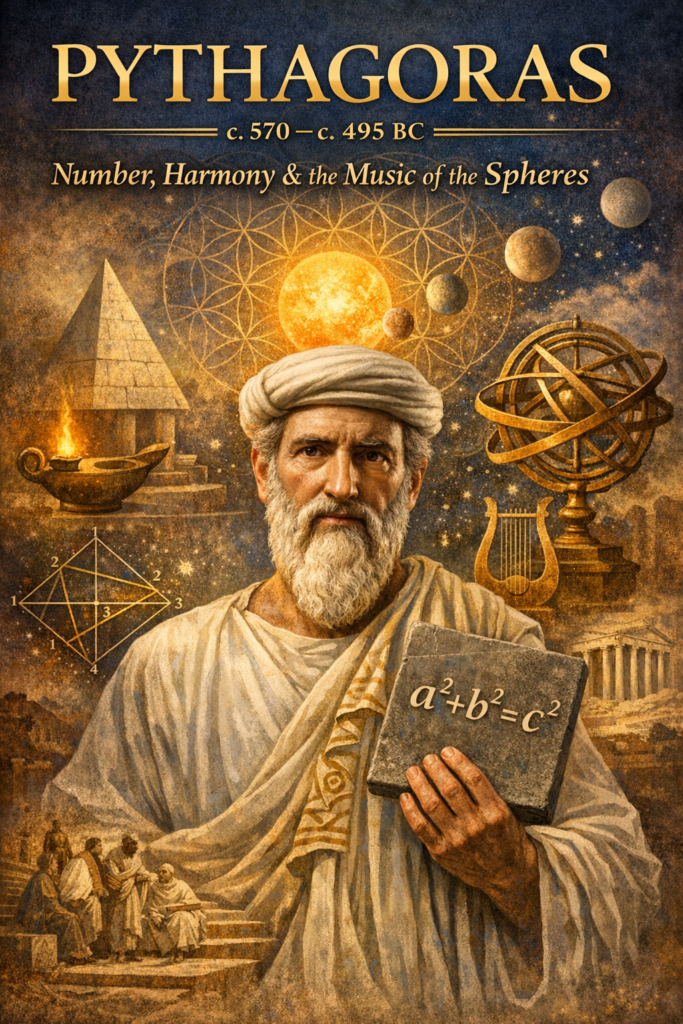
In the Pythagorean view, harmony governs the soul, the heavens, and the hidden architecture of life, revealing a cosmos alive with proportion, rhythm, and spiritual meaning.
To approach Pythagoras is to step into a world where philosophy becomes very practical, and where the contemplation of number opens the mind to the deeper music of reality and a more harmoneous lifestyle.
Pythagoras Key Facts
Who was Pythagoras?
-
Pythagoras of Samos was an early Greek philosopher traditionally placed around c. 570–490 BCE, who later settled in Croton in southern Italy and became the focal figure of a disciplined philosophical-religious community.
-
He is difficult to reconstruct historically because he wrote nothing himself, and many later accounts mix genuine teaching with legend.
Why is number so important in Pythagorean thought?
-
Pythagoreanism became famous for treating number as the key to order, proportion, and intelligibility in the cosmos. Aristotle’s reports, as summarized by Britannica, present number-speculation as one of its most characteristic features.
-
In spiritual terms, number can be understood not as dry calculation but as a symbol of hidden law: reality is structured, measurable, and harmonious rather than chaotic.
Here is a concise list of mathematical examples where Pythagoras or the Pythagorean tradition presents calculation as an expression of hidden law:
-
The Pythagorean Theorem: The sides of a right-angled triangle obey a fixed numerical law: geometry is governed by intelligible order.
-
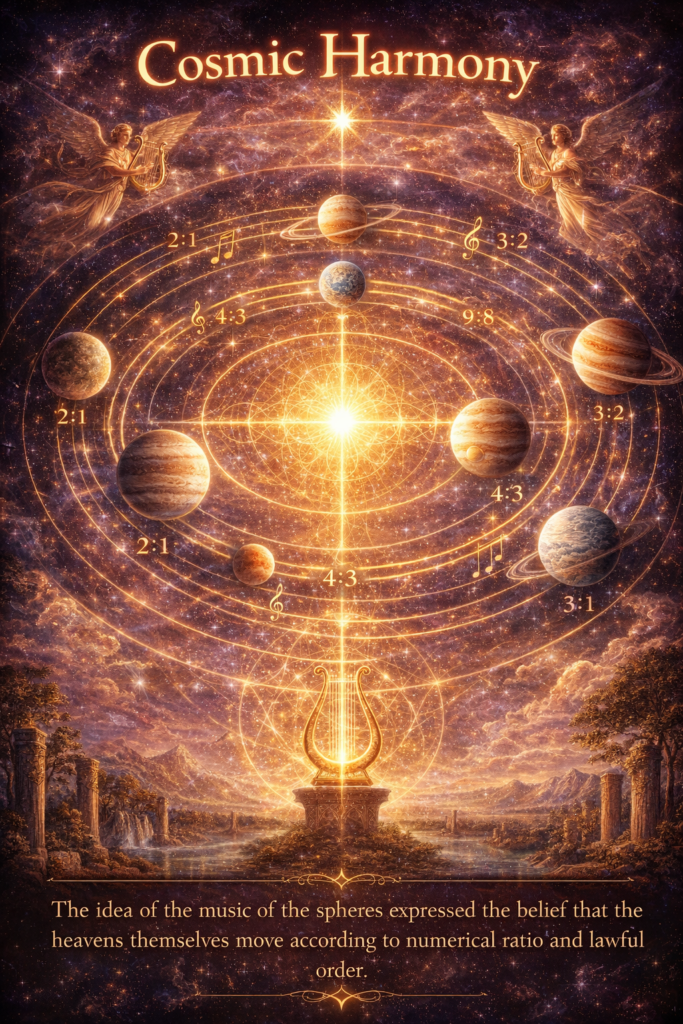
Musical Ratios: Harmony arises from simple number relations such as 2:1, 3:2, and 4:3, showing that beauty and sound follow measurable proportion.
-
Tetractys (1+2+3+4=10): The sacred decad expresses number as a generative pattern underlying structure, wholeness, and cosmic order.
-
Odd and Even Numbers: The distinction between odd and even was treated as symbolic of deeper principles, suggesting polarity and order within existence.
-
Figurate Numbers: Numbers could be arranged into shapes, such as triangular and square numbers, revealing form hidden within arithmetic.
-
Proportion and Symmetry: Mathematical proportion showed that balance and measure are built into reality rather than imposed upon it.
-
Cosmic Harmony: The idea of the music of the spheres expressed the belief that the heavens themselves move according to numerical ratio and lawful order.
What is the link between Pythagoras and Music?
1. The Monochord Experiment (Ratio as Revelation)
Pythagoras used a single-string instrument (monochord) to discover that harmonious sounds arise from simple ratios:
-
-
2:1 → Octave
-
3:2 → Fifth
-
4:3 → Fourth
-

Mystical teaching: Harmony is not subjective—it is built into the fabric of reality. The ear perceives what number already orders.
2 Harmony as a Model of the Soul
-
The soul was understood as something that can be “tuned” like a musical instrument.
Practical implication:
-
Ethical living = bringing the soul into correct proportion
-
Disorder = dissonance
Mystical teaching: Spiritual practice is a process of inner tuning, aligning one’s being with universal harmony.
3. Music as Purification (Katharsis)
-
Pythagoreans reportedly used specific musical modes and chants:
-
To calm anger
-
To prepare for sleep
-
To restore inner balance
-
Mystical teaching: Sound acts directly on the psyche, helping to purify and rebalance consciousness.
4. Silence and Inner Hearing
-
Pythagorean students underwent periods of silence (akousmatikoi discipline).
Mystical teaching: Outer sound leads to inner sound—a subtler perception of harmony beyond the physical ear which directly relates to the Path of Light and Sound.
What did Pythagoras teach about the soul?
-
One of the core teachings linked to Pythagoras is the immortality of the soul and its transmigration from one life to another.
-
This gives his philosophy a strongly mystical tone: human life is not confined to one lifetime, and conduct in this life matters because the soul is on a longer journey of purification. This second point is an interpretive reading, but it follows directly from the ancient emphasis on metempsychosis (the supposed transmigration at death of the soul of a human being or animal into a new body of the same or a different species.)
- For Pythagoras, metempsychosis was not simply rebirth, but the soul’s long pilgrimage through successive embodiments. Each life offered an opportunity for purification, moral refinement, and deeper attunement to the divine order hidden within number, harmony, and cosmic law.
Pythagoras’ Principles & The Light and Sound Meditation
- Pythagoras suggests that truth is approached through alignment, not mere information. The seeker must become inwardly ordered. The Path of Light and Sound is a practical meditation path, which has to realised internally, not just understood by the intellect.
-
Pythagoras teaches that spiritual life is a matter of attunement to a deeper order. For the Light and Sound practitioner, this suggests that the Inner Light and Sound are not random experiences, but expressions of a subtler harmony already present behind the outer world.
-
His emphasis on discipline is highly relevant to the path. Progress in Light and Sound meditation is rarely gained through strain or force, but through regular practice, sincerity, inward recollection, and a life that gradually becomes more ordered and balanced.
-
The Pythagorean idea of harmony can also be applied in a practical way. The practitioner benefits from simplifying life, reducing unnecessary noise and disturbance, and creating conditions in which attention can turn more easily toward the inner current.
-
Pythagoras’ association with music is especially meaningful here. Just as harmony reflects hidden proportion, the Inner Sound may be understood as a living spiritual current that draws consciousness away from mental restlessness and toward a finer centre of awareness.
-
In this way, meditation becomes more than a technique. It becomes a process of inner re-tuning, in which the whole being is gradually brought into greater receptivity to the Light and resonance with the Sound.
-
Finally, Pythagoras’ teaching on the soul’s journey gives a wider spiritual context to the practice. Light and Sound meditation is not only a means of peace or clarity, but part of the soul’s long work of purification, alignment, and return to its deeper source.
Concluding Thoughts
-
Pythagoras remains meaningful not only as an early philosopher, but as a guide to spiritual orientation.
-
His vision of harmony, discipline, and the soul’s ascent speaks directly to the Light and Sound path as well as many other spiritual paths.
-
In this path, inner refinement opens the way to deeper perception.
-
Read in this way, his teachings become not merely a system of thought, but a quiet call to live, meditate, and listen in greater alignment with the hidden order of the soul.