Atlantean Root Race: A Warning About Power
The Atlantean Root Race is the great “middle chapter” in the Root Race story: the era where form becomes fully dense, desire intensifies, the mind begins to sharpen, and civilisation in esoteric terms reaches impressive heights—then collapses under the weight of power misused. What follows here, is symbolic history, not a geological reconstruction—something meant to be contemplated, not “proven.” In the concluding section we look at a powerful practical application of Atlantean mythology.
Why is Atlantis the most popular of Root Races?
Because Atlantis sits at the perfect crossroads of myth, mystery, and modern psychology:
-
It has an established Western source (Plato), so it feels ‘anchored’ compared to other root race chapters.
-
It’s cinematic: a brilliant civilisation + sudden catastrophe is an irresistible story engine.
-
It mirrors our era: technology, power blocs, propaganda, spectacle and ecological anxiety.
-
It offers a moral arc: rise → excess → collapse → overall lesson—simple enough to retell endlessly.
-
It invites personal projection: everyone can place their own fears and hopes into “Atlantis” (lost innocence, lost mastery, lost wisdom).
- If Lemuria feels like “a dream of harmony,” Atlantis feels like “a warning about force.”
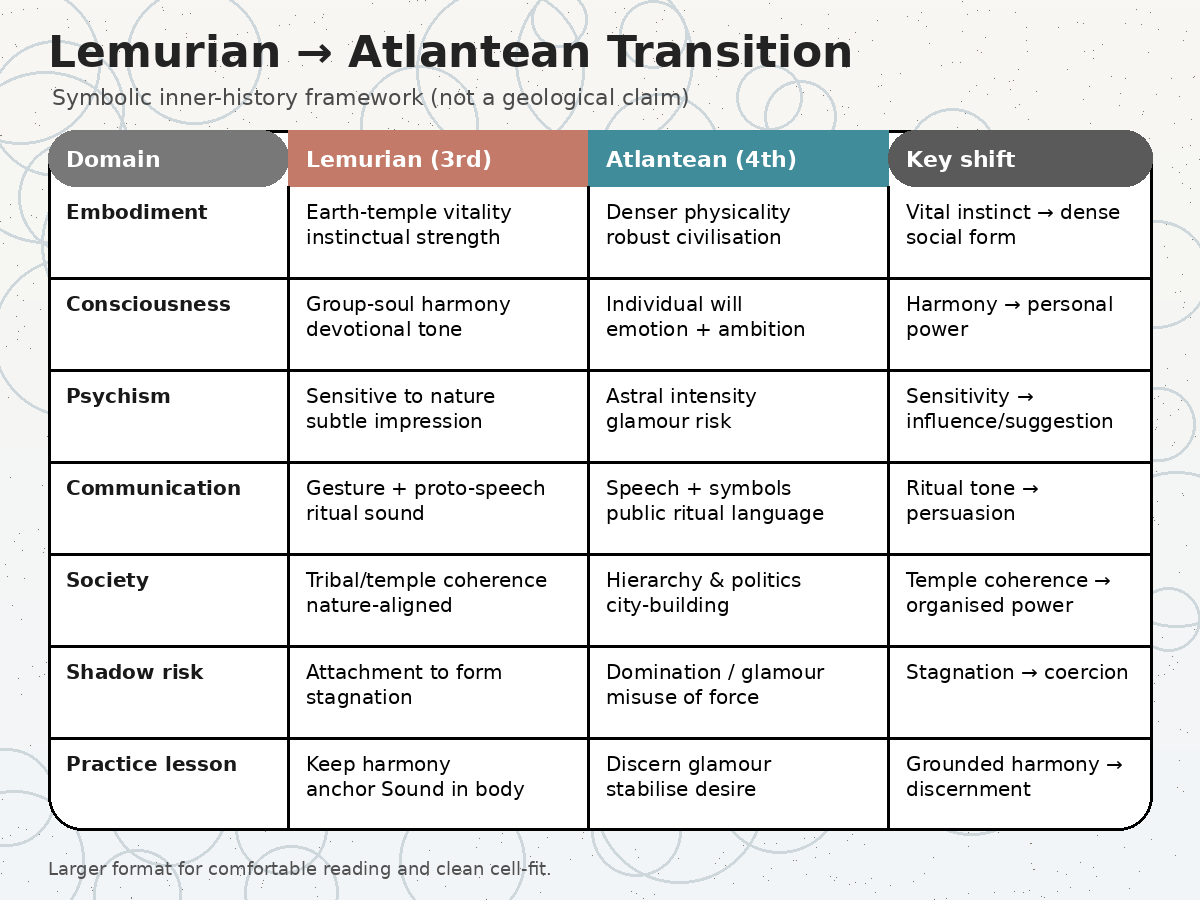
What characterises the Lemurian-Atlantean Transition?
The felt shift from Lemuria → Atlantis, in symbolic terms, is often described as:
-
From earth-aligned innocence → emotional intensity and power
-
From “group-soul harmony” → strong individuality, ambition, and conflict
-
From temple-nature spirituality → organised priesthood, occult science, and politics
-
From subtle/elemental communication → fuller speech, record-keeping, and complex societies.
We can summarise the major differences in the table below:
What was the Earth like in Atlantean times—landmasses, climate, oceans?
Theosophically speaking, Atlantis is typically described as a large Atlantic land-system with multiple islands/regions, gradually fragmented by cataclysms and inundations.
This geography reflects esoteric tradition and symbolic mapping, not modern plate-tectonic reconstructions.
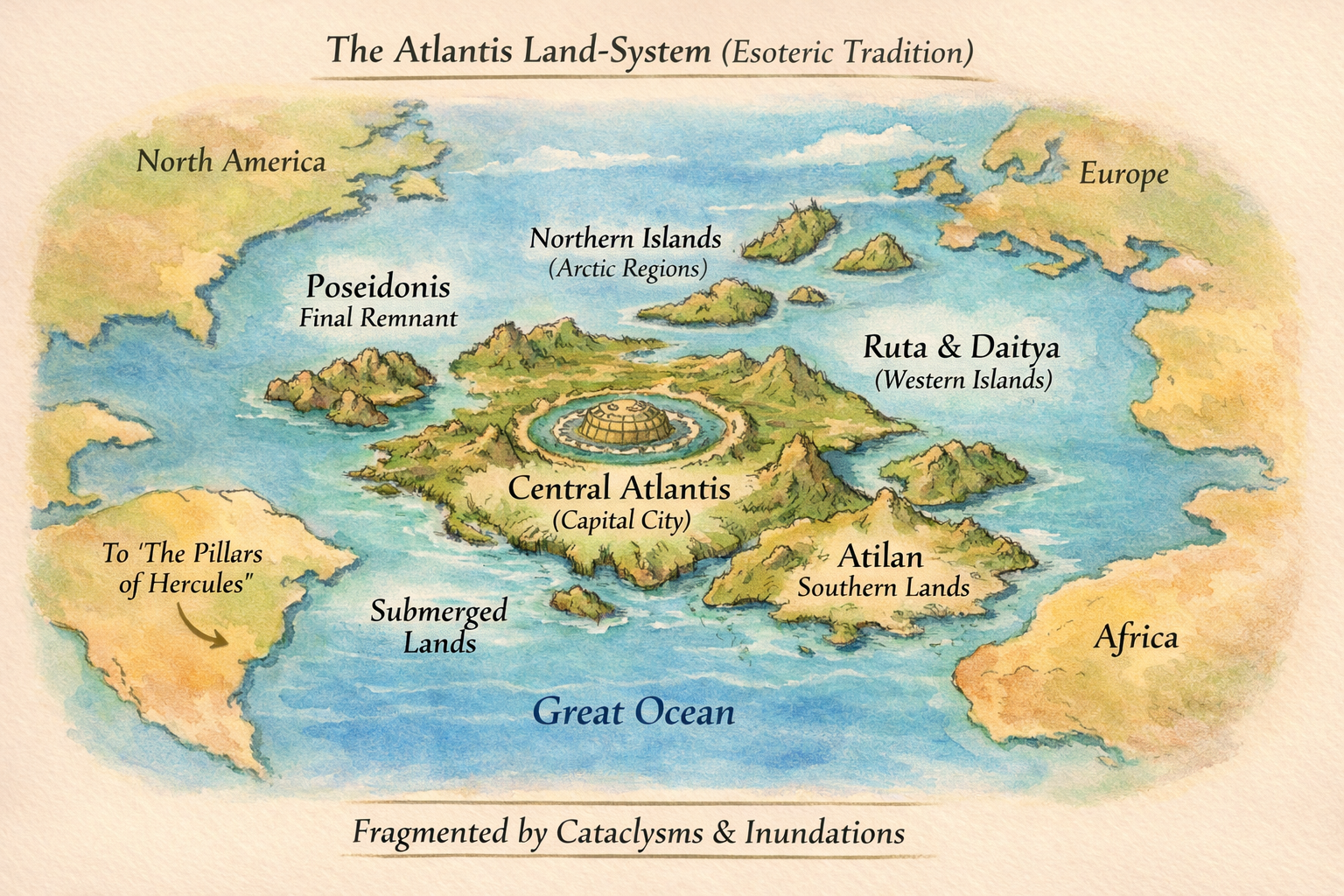
- Most popular sources place Atlantis in or around the Atlantic (often ‘beyond the Pillars of Hercules’ in the Platonic telling).
- In later esoteric frameworks, the “seat” becomes a spiritual-geographic symbol: the ocean as the domain of emotion, memory, and collective dream—fitting the Atlantean emphasis on desire, psychism, and power.
What were the Atlantean Characteristics?
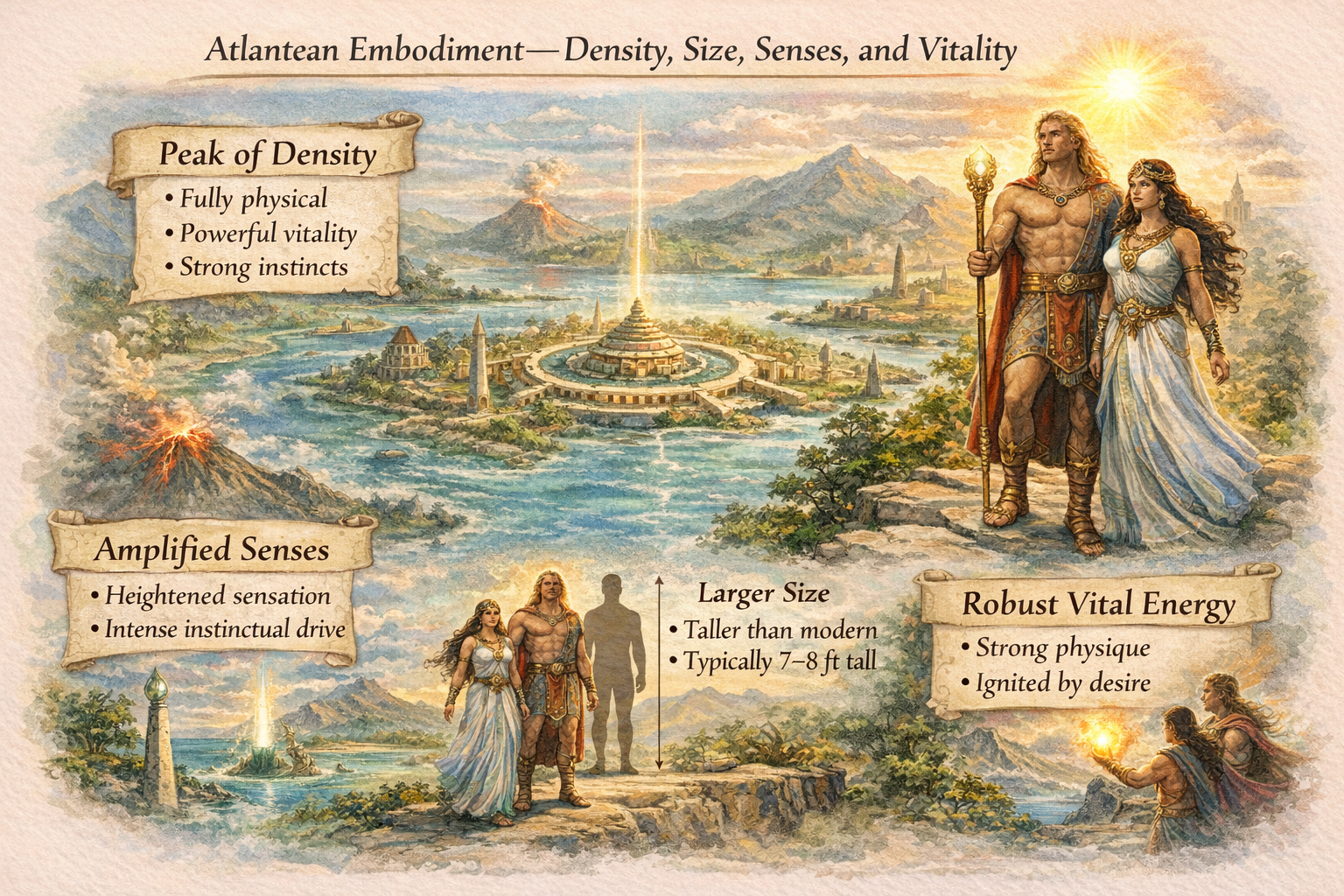
- A common esoteric theme is that Atlantean humanity represents the peak of density/materiality in the cycle—
- robust vitality,
- strong instincts,
- pronounced sensation, and
- a more fixed ‘human’ outline than earlier epochs.
- Symbolically, this is the point where spirit is most deeply in matter, so the consequences of ethical choice feel sharper.
What characterised Atlantean Consciousness and Speech?
- If Lemuria is ‘harmony with nature,’ Atlantis is often portrayed as the intensification of the astral/emotional body—desire, fear, charisma, domination, glamour—paired with a quickening mind that can rationalise, plan, and manipulate.
- Atlantis is therefore where consciousness becomes strategic.
- This is why Atlantis is such a useful mirror for modern life: many of our challenges are still Atlantean in flavour—information overload, persuasion, spectacle, tribalism, and the seduction of power.
- In speech esoteric accounts tend to move from “impression/resonance” toward fuller speech, symbol systems, and socially shared ritual language—while still retaining a strong “psychic atmosphere” (group suggestion, glamour, fear contagion).
- That mix—language + psychic field—is exactly why the Atlantean chapter is often described as spiritually dangerous: it’s easy to confuse intensity with truth.
What Governed Atlantean Daily Life
Atlantean daily life had four elements:
-
Infrastructure: cities, waterways, metallurgy/craft and trade routes
-
Authority: kingship and councils, priesthoods and schools of discipline
-
Ritual culture: public ceremony, seasonal rites and temple economies
-
Power dynamics: class stratification, conquest, and ideological control.
-
Tradition remembers civilisation becoming highly organised—capable of beauty and order, but also coercion.
What is meant by Atlantean Magic?
Magic can be framed as intentional influence:
-
influence over oneself (discipline, concentration, ritual)
-
influence over others (suggestion, glamour, persuasion)
The “fall” motif appears when influence becomes domination—when desire outruns conscience.
What triggered the Atlantean cataclysms and the transition into the next Root Race?
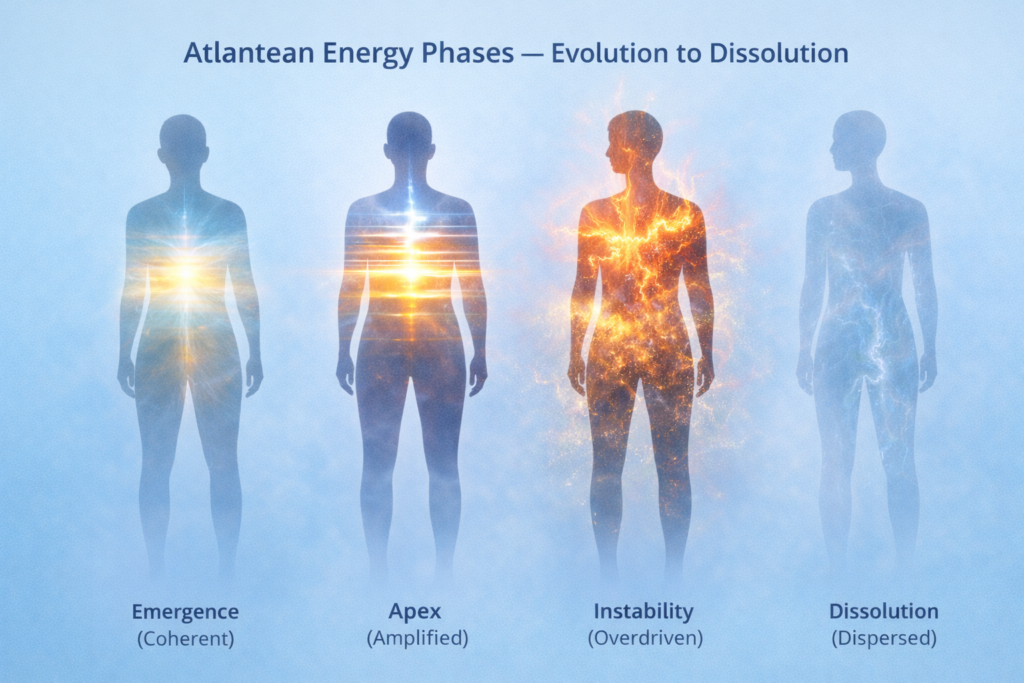
The transition is driven by two converging pressures:
-
Inner pressure: misuse of power, psychic corruption, materialism and loss of alignment
-
Outer pressure: “flood” imagery—nature rebalancing what consciousness distorted
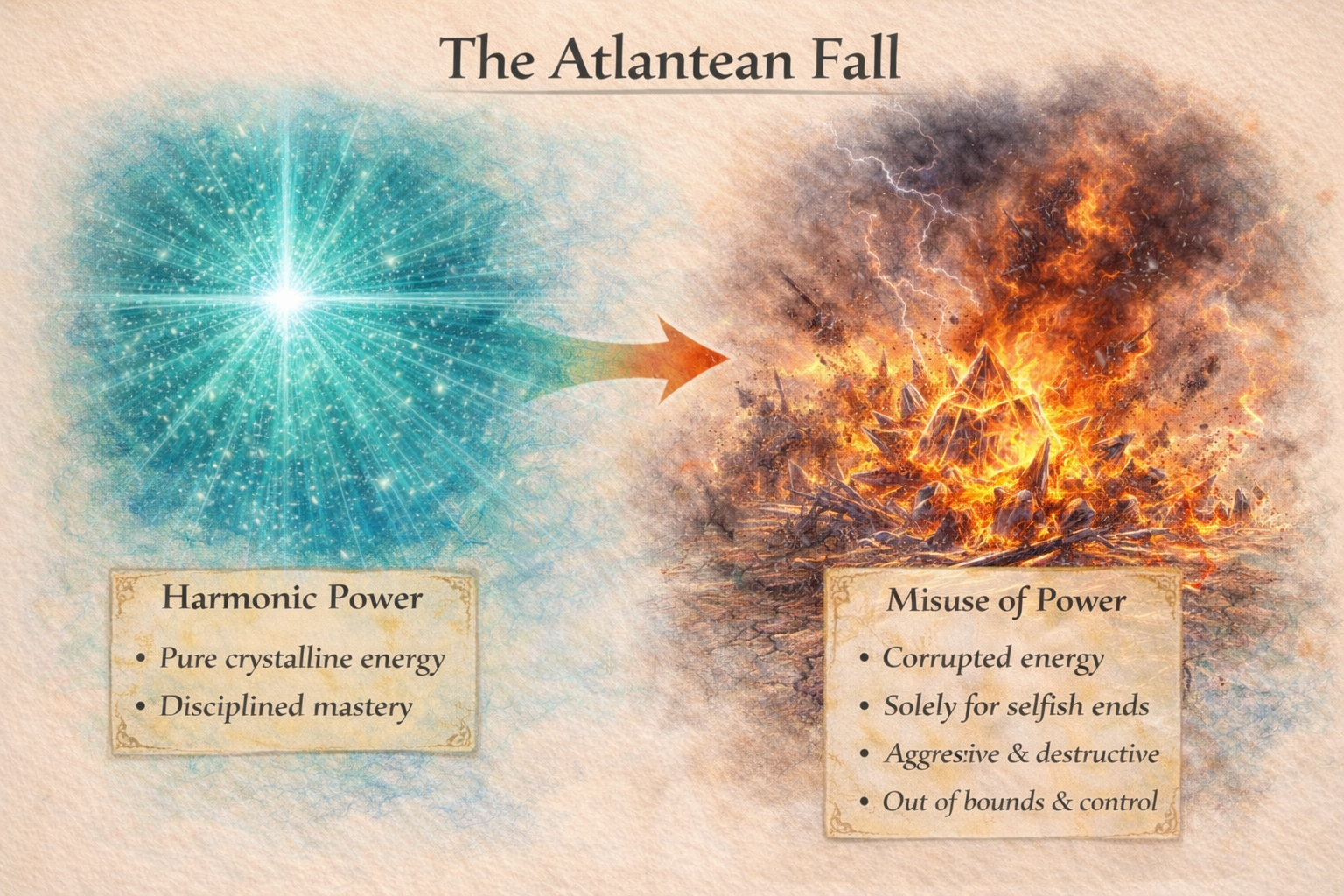
“The first swirling of Atlantean disharmony were not dramatic catastrophes, but small inner permissions. Power began to outrun purity: capacity was tasted for advantage, not alignment. The psychic atmosphere thickened into glamour—intensity, fascination, suggestion—so that feeling replaced truth as the social compass. Desire quietly took the steering wheel and conscience became negotiable. The ‘fall’ is simply the outer echo of that inner drift: when a civilisation cannot govern the forces it awakens, the very sea of its own astral nature rises and claims it.”
What were Plato’s writings on Atlantis?
Atlantis enters Western literature through Plato’s dialogues (Timaeus and Critias), where the story functions as a philosophical myth—an image of a powerful maritime civilisation brought down through moral and political failure.
“In Critias, he paints a civilisation of immense resources, engineering genius, and imperial reach—rings of water and stone, harbours and canals, metals and splendour—so that we feel the full weight of capacity before we witness its distortion. The point is not that Atlantis lacked brilliance, but that brilliance is different from virtue.
Atlantis becomes a mirror for any culture where power expands faster than conscience: when wealth, influence, and persuasive force grow beyond inner governance.And the fall, as Timaeus frames it, is the outer echo of an inner crossing: the moment when greatness, unguided by measure, collapses into the sea of forces it could no longer rule.”
What does Atlantis Symbolise in Human Development?
- Atlantis symbolises the birth of potent individuality—the realisation “I can”—followed by the testing question: “Should I?”
- It is the epoch where charisma, desire, and intelligence begin to shape reality at scale. Its fall is the lesson that consciousness must mature ethically as quickly as it matures technically.
Light & Sound Application: Atlantis as a Literal Inner-Life Sequence
1) The Rise: practice starts working
- Mythic: a great civilisation forms.
- Literal: your Light and Sound practice becomes steady; you feel clearer, more energised, more “guided.”
- Markers: calm concentration, increased sensitivity, stable routine, better ethics/temper.
2) The Golden Age: capacity expands
- Mythic: wealth, structure, power, beauty.
- Literal: you develop genuine inner resources—stronger will, deeper silence, more influence in your life, sometimes spontaneous insights.
- Risk: you begin to identify with capacity (“I’m progressing,” “I am special,” “I can do this for others”).
3) The First Swirling: glamour enters
- Mythic: persuasion becomes manipulation; power outruns purity.
- Literal: subtle substitutions creep in:
-
intensity replaces truth (“big experiences” become the goal)
-
certainty replaces inquiry (rigidity)
-
influence replaces service (wanting others to see/validate)
- Risk: psychic noise replaces Inner Sound (compulsion, fascination), spiritual comparison with other people and groups, subtle dishonesty, chasing phenomena.
4) The Misuse: force without governance
- Mythic: domination, spectacle, distortion.
- Literal: you push practice for results, bypass emotions, or use “spirituality” to control life/relationships.
- Signs: depletion, irritability, grand plans, “mission energy,” loss of humility, blurred boundaries, dependency on highs, Spiritual self-importance rather than service.
5) The Flood: the system collapses
- Mythic: inundation and fragmentation.
- Literal: your psyche rebalances. The repressed material rises fatigue, anxiety, old grief, cravings, doubt, discouragement. Life may also ‘flood’ you with friction (conflicts, setbacks) because your inner structure cannot hold the load you put on it.
- This is not failure. It is is consequence + correction.
6) The Remnant: what survives is real
- Mythic: fragments remain; a new phase begins.
- Literal: what is left after the crash is the true path: simpler practice, cleaner motives, steadier humility. Your work becomes less dramatic but more reliable.
Light → clarifies cutting through glamour, emotional theatre, and fascination.
Sound → stabilises and gathers scattered desire back into a single current.
When “Atlantean energy” is active in us—compulsion, intensity, the need to persuade, the urge to control— our Light and Sound practice becomes the inner counterbalance giving clarity + steadiness.
Meditation Websites