The Lemurian Root Race
Humanity’s First Earth-Aligned Civilization
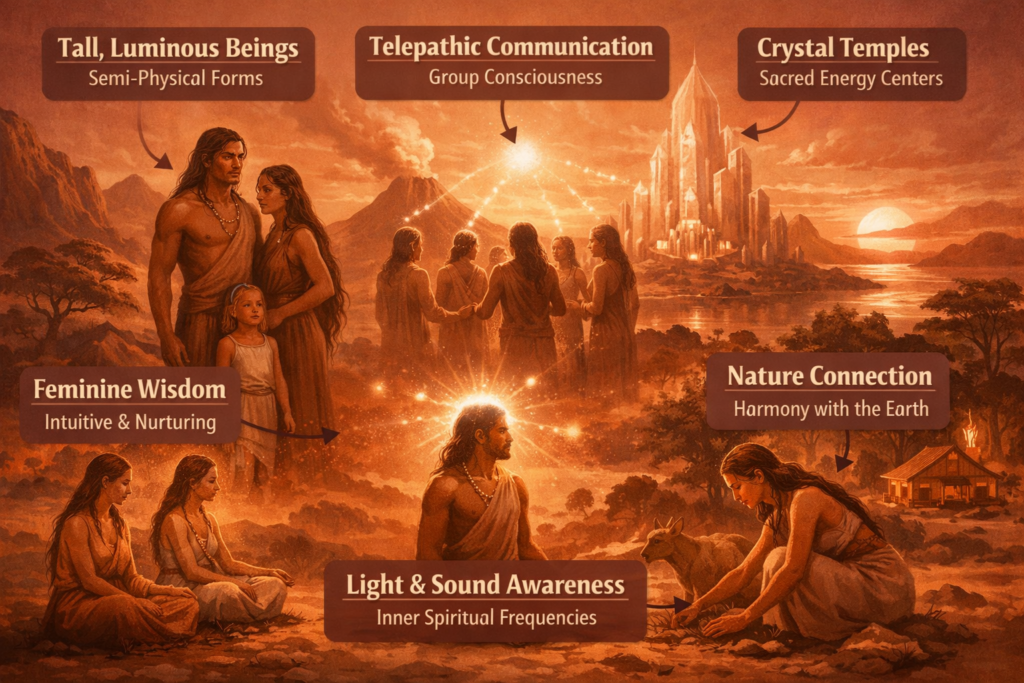
What Was the Lemurian Root Race?
“The Lemurian Root Race was humanity’s first true partnership with the Earth, a civilization formed not through dominance, but through resonance.”
Lemuria represents a pivotal phase in human evolution, following the largely etheric Hyperborean age. While earlier races hovered lightly within matter, Lemurians lived with the Earth, embodying physical form while remaining deeply attuned to subtle energies.
Often remembered as Mu or the Motherland, Lemuria was less a lost continent and more a lost state of consciousness, one that modern humanity is only now beginning to remember.
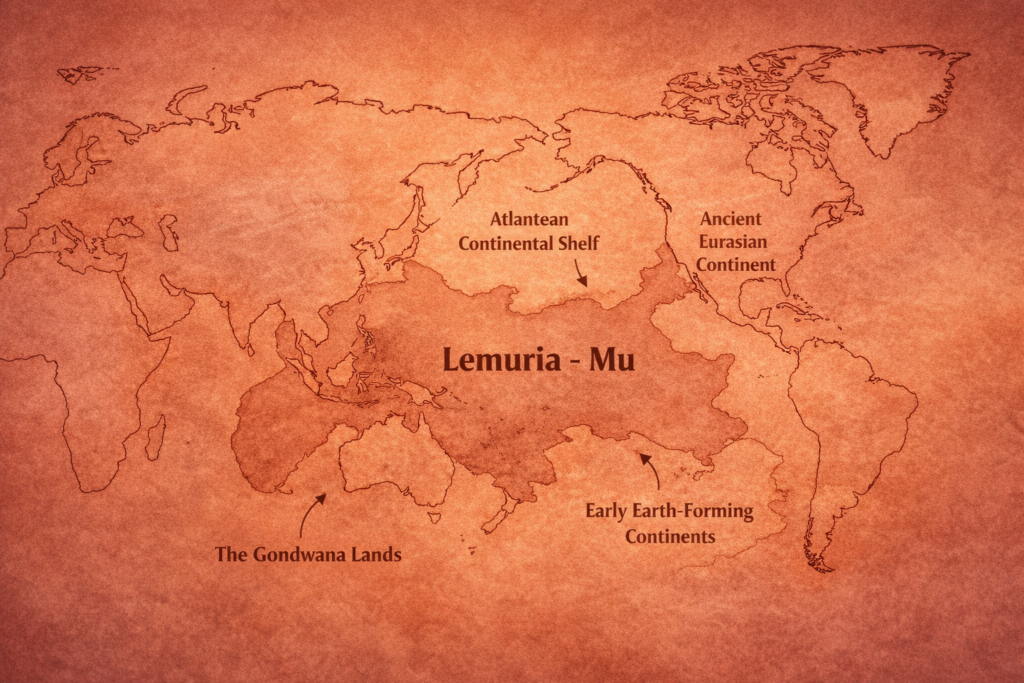
Was it a random event to centralise Lemuria.Why not the northern/eastern/western hemispheres?
“Because the ‘hemisphere’ idea is modern. Esoteric maps aren’t thinking in cardinal directions so much as functions:
some regions anchor density,
some regions circulate life-force,
some regions specialize consciousness development.”
Lemuria isn’t primarily “a continent,” it’s “a field where a certain kind of humanity could emerge.”
Why the Pacific zone specifically, in Esoteric Terms?
“Three currents are repeatedly implied in esoteric mapping:
Planetary grid convergence
The Pacific is framed as a major basin where large-scale currents can circulate and redistribute energy. In symbolic geography, that makes it ideal for a civilization centered on resonance rather than dominance.Volcanic and crystalline synergy
Lemuria is often linked with volcanic fire (transformation) and crystalline order (coherence). The Pacific ‘Ring of Fire’ imagery fits the mythic pattern: a region of intense reshaping, where a semi-etheric humanity could gradually acclimatize to density.Balancing function against the “Earth-forming” southern anchors
In the model we’ve been using, the denser southern landmasses act like stabilizers. Lemuria–Mu acts like a living interface: not as heavy as the anchors, not as airy as earlier epochs. The Pacific placement expresses that “in-between” role.”
Does this Continental Map align with the Geological Record ?
Modern geology is built on plate tectonics and a well-dated history of supercontinents (Pangaea, Rodinia, etc.), reconstructed from:
-
seafloor magnetic stripes and plate motion models
-
radiometric dating
-
fossil distributions and stratigraphy
-
paleomagnetism and craton histories
Within that framework:
-
There’s no accepted evidence for a large Pacific “lost continent” like Lemuria–Mu in the way esoteric maps depict it.
-
The idea that a region is “more etheric / less dense” is outside geology’s scope, because geology only models physical matter and measurable processes.
-
“Southern landmasses” are explained via known continental pieces (e.g., Gondwana fragments) and plate reconstructions, not distinct “density bands.”
“This map reflects esoteric tradition and symbolic geography rather than modern plate-tectonic reconstructions. It is intended as a visual expression of ancient metaphysical teachings that describe shifts in consciousness, embodiment, and humanity’s relationship with the Earth, not as a literal geological model.”
What were the Southern Early Earth-Forming Continents
-
A southern extension of the Lemurian landmass
-
A region associated with early densification of matter
-
Transitional zones where Lemurian consciousness began adapting to heavier physicality
-
What later traditions loosely associate with proto-Gondwanan or submerged southern lands
How Did Lemurians Experience Physical Form?
- Lemurians inhabited semi-physical bodies, denser than their Hyperborean predecessors yet still infused with Light. Their forms were tall, fluid, and long-lived, shaped more by energy than by bone density as we know it today.
“Gravity was not yet resistance, the body was an instrument, not a limitation.”
- Physicality was experienced as a joyful descent rather than a fall, a way of participating more fully in the living intelligence of the planet.
How Was Lemurian Society Organised?
There were no rigid hierarchies in Lemurian civilization. Society was guided by resonance, sensitivity, and collective attunement rather than authority or power structures.
Key features of Lemurian social consciousness included:
-
Group awareness over individual identity
-
Telepathic communication as a natural faculty
-
Shared responsibility rather than leadership roles
-
Deep alignment with planetary and cosmic cycles
- Children were recognised as carriers of wisdom, arriving already connected to collective memory rather than needing instruction.
Why Is Lemuria Associated with the Feminine Principle?
- Lemuria is often described as matriarchal, but more accurately it was feminine-aligned.
- Receptivity, intuition, and gestation formed the foundation of culture, balanced naturally with the masculine principle of action and expression.
“The Earth was not worshipped as a deity, she was recognised as kin.”
- Sacred sites functioned as energetic nodes, often working with crystalline structures that amplified harmony between human consciousness and the planetary grid.
How Did Lemurians Experience Light and Sound?
- Lemurians lived in constant awareness of Light and Sound. These were not mystical events reserved for meditation, but everyday aspects of perception.
- Sound was experienced as a guiding inner current, while Light was seen both inwardly and throughout the natural world. There was no separation between spiritual awareness and daily life.
“This was not spirituality as a practice, it was spirituality as a state.”
What Led to the End of Lemurian Civilization?
As humanity continued to descend into density, Lemurian consciousness became increasingly incompatible with the evolving physical world. Individual identity strengthened, separation emerged, and the deep unity with Earth gradually faded.
Rather than collapsing suddenly, Lemuria dissolved slowly. Some populations migrated physically, others withdrew energetically, and many incarnated later into Atlantean and post-Atlantean humanity.
“What ended was not a land, but a way of being.”
How Does Lemuria Still Influence Humanity Today?
The Lemurian imprint remains strong in those who feel:
-
A profound bond with nature
-
Discomfort with rigid systems and hierarchies
-
Natural sensitivity to energy, Light, and Sound
-
A sense of grief or longing for an unremembered home
Many modern awakenings are less about learning something new and more about remembering something ancient.
Why Does the Lemurian Root Race Matter Now?
As humanity approaches another evolutionary threshold, the Lemurian memory returns with renewed relevance. What was once lived unconsciously must now be embodied consciously.
“In remembering Lemuria, humanity recovers a missing blueprint for the future.”
The Lemurian Root Race does not belong to the past alone. It offers guidance for a new relationship with the Earth, one based on cooperation, resonance, and living Light.
Meditation Websites
