Thales of Miletus: Philosophy & Mysticism
Key Philosophy of Thales
Thales was one of the first Pre-Socratic Philosophers; a mix of early Greek thinkers mainly from the 6th and 5th centuries BCE, who shifted explanation of the world from myth to reason.
Instead of asking what the Gods want, they ask what reality is, and they use careful thought and observation to answer that question.
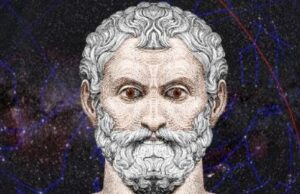
Here are 5 solid facts about Thales of Miletus:
- He’s often called the “first philosopher” in the Western tradition
Thales (c. 624–c. 546 BCE) is traditionally placed at the start of Western philosophy and he tried to explain the world using reason and natural causes, rather than myth. -
He taught that the basic principle of everything is water
Thales’ famous claim is that the archê (first principle) of all things is water – meaning that everything ultimately comes from, or is grounded in, water in some way. -
He was also a mathematician and is credited with “Thales’ Theorem”
In geometry, Thales’ theorem states that if A, B, and C are points on a circle with AC as the diameter, then angle ABC is a right angle. Ancient sources credit him with several early geometric discoveries.

4. He is said to have predicted a solar eclipse
Herodotus reports that Thales predicted a solar eclipse that occurred during a battle between the Lydians and the Medes (usually dated to 585 BCE). Historians debate how precise this “prediction” really was, but the story is famous.
5. He was said to one of the seven sages of Greece
In later tradition, Thales was counted among the Seven Sages, wise early figures known for their practical wisdom and concise sayings ,like “Know thyself .”
Thales Philosophy Applied to Mysticism
Thales wasn’t working with the specific Energies of Light and Sound, however we can apply some of his work to what is relevant to this meditation path:
Here’s how his contribution connects:
1. From Myth to Direct Inquiry
Thales tried to explain the world without mythology, asking “What is really going on underneath all this?”
On the Light and Sound Path, we do something very similar inwardly: instead of relying on belief or dogma, we sit, open, and observe the Inner Light, Sound, and states of consciousness directly.
2. The Search for a Single Underlying Principle
Thales said the archê (first principle) of everything is water. It’s not our view now, but the move is important: he intuited that all diversity might come from one subtle Source.
On the Light and Sound Path, One featureless Energy pervades everything, manifests through higher and lower dimensions, and eventually appears as Light, Sound, and matter.
“From the Darkness comes the Light, from the Silence comes the Sound, from the Nothing comes the Something.”
So Thales’ “water” is like a very early ‘intuition of unity’ which can be known directly throguh meditation.
3. Geometry, Patterns and Inner Light
Thales is linked with early geometry and proportion. The Light and Sound path contains precise geometries, forms and colours that express the structure of creation in Spiritual Light.
There is potential for the meditator to see geometry within the Light and recognise that creation is “designed” on multiple levels.
4. The Intelligence of the Cosmos
Ancient sources say Thales held that “all things are full of gods” – in modern language, that reality is alive with subtle intelligence.
The Spiritual Hierarchy comprise universe filled with Beings of Light and Higher Intelligences guiding human evolution.
This means even the scientific and philosophical breakthroughs of people like Thales can be seen as part of this ongoing collaboration between human minds and higher consciousness.
5. Applying Meditation Experiences to Live more Wisely
Thales didn’t just speculate; he applied his insight, for example in geometry and (traditionally) in predicting eclipses, to guide practical decisions.
On the Path, the Light and Sound are not just “nice experiences” to witness. They help us see the bigger pattern of life, detach from the drama, and live with more wisdom while remaining “in the world but not of it.”
Meditation Links
Philosophy Links
